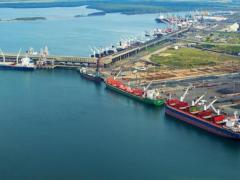
RAY SMUTS IT HAD all the makings of a cracking Hammond Innes read - a ship partially submerging to offload two on-deck ‘passenger’ vessels. But this was no tale of war-intrigue, rather modern-day Saldanha showing its mettle in becoming the first South African port to handle such a specific brief. Like its sister port of Cape Town, the port of Saldanha is anxious to capitalise on the many ship repair and maintenance opportunities afforded by the West African oil and gas boom, and this operation provided just the right sort of incentive to chase further business. “This shows that apart from having the necessary port infrastructure we also have the marine capability to handle projects of such a nature in support of the very lucrative emerging oil and gas sector a few hundred nautical miles from Saldanha,” says port manager Eugene Kearns. According to harbour master Captain Ravi Naicker, Saldanha was chosen for the operation because it is the country’s largest deepwater port. It is only possible to submerge 13,5 metres in the port of Cape Town but the operation to hand called for greater depth to allow the 225-metre vessel Blue Marlin - one of the larger to call at Saldanha - to submerge about 20 metres below the waterline, allowing the two oil vessels West Manang and Smedvig T8, to come free. “The nine-hour operation involved two NPA tugs, a pilot and pilot boat, and a working vessel, and went off without a hitch,” says Naicker. Thereafter, the tug Suhaili towed the West Manang to Cape Town for repairs while the Smedvig T8 left under tow for the Democratic Republic of Congo and and the Blue Marlin for Singapore. Last year the spin off to the Western Cape in refitting just one vessel, the Glas Dowr, was around R300 million. While the Saldanha operation realised nowhere near that figure it is, as Kearns correctly points out, at least a promising start. “Current revenue from servicing oil and gas-related vessels is negligible but it’s a strong focus in terms of the port’s growth and development.”
Saldanha does some fancy footwork to handle submerged vessels
Comments | 0
© Now Media. This content is protected by copyright and may not be adapted or republished. If you would like to discuss cooperation opportunities, please contact: editor@freightnews.co.za.