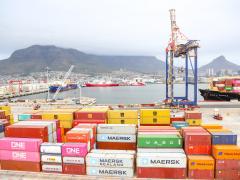
The UK’s newest container terminal, while still under construction on the north bank of the River Thames, has secured its first caller. The Southern Africa Europe Container Service consortium (Saecs) that comprises MOL, Deutsche Afrika-Linien (DAL), Maersk and Safmarine, last week became the first customer to confirm its intention to start calling at London Gateway in November this year. The first vessel, the MOL Caledon, is scheduled to arrive at the port on November 7. In a short communiqué to shippers, Safmarine and Maersk confirmed that the Saecs member lines had decided to move their UK call from the London Container Terminal Tilbury to the new London Gateway Terminal. “The Saecs members are proud to be a front runner in this port development in the UK,” reads the communiqué. “With this change of terminal the lines aim to secure not only benefits for their clients through the improved infrastructure, but also operational advantages such as enhanced schedule integrity and reliability, while enabling their clients to further streamline their supply chains.” Whilst no further comment could be obtained around the impact of the move on South African shippers in particular, the decision by the lines is regarded as a coup for the new port. Owned by DP World, the port earlier this year announced that Marks and Spencer would be the first customer at its logistics park. Set to be the UK’s first 21st century deep-sea container port and Europe’s largest logistics park, its location – just 25 miles from central London on the former Shell Haven oil refinery location at Stanford-le-Hope on the north bank of the Thames – makes it a more viable option for many ocean carriers to Tilbury, a tidal port where vessels can only berth during high tide. At the same time London Gateway is also expected to reduce the cost of road miles. “We have reduced the number of lorries on the road in the construction of London Gateway and we offer our customers the ability to reduce their lorry miles and save on CO2, fuel and time costs as London Gateway is simply closer to the UK’s major markets, not just in the South East but also the Midlands and the North West,” reads a statement released earlier by the port. Considered to be the most significant UK port development in 20 years, it has a quay length of 2700 metres, six berths, 24 quay cranes and a terminal area of 175 hectares. Its ultimate aim, according to DP World, is to increase the efficiency of the UK logistics supply chain by providing a port that is more easily accessible and offers faster turnaround time of vessels and shorter distances to markets.
Saecs switches to new London Gateway
Comments | 0
© Now Media. This content is protected by copyright and may not be adapted or republished. If you would like to discuss cooperation opportunities, please contact: editor@freightnews.co.za.