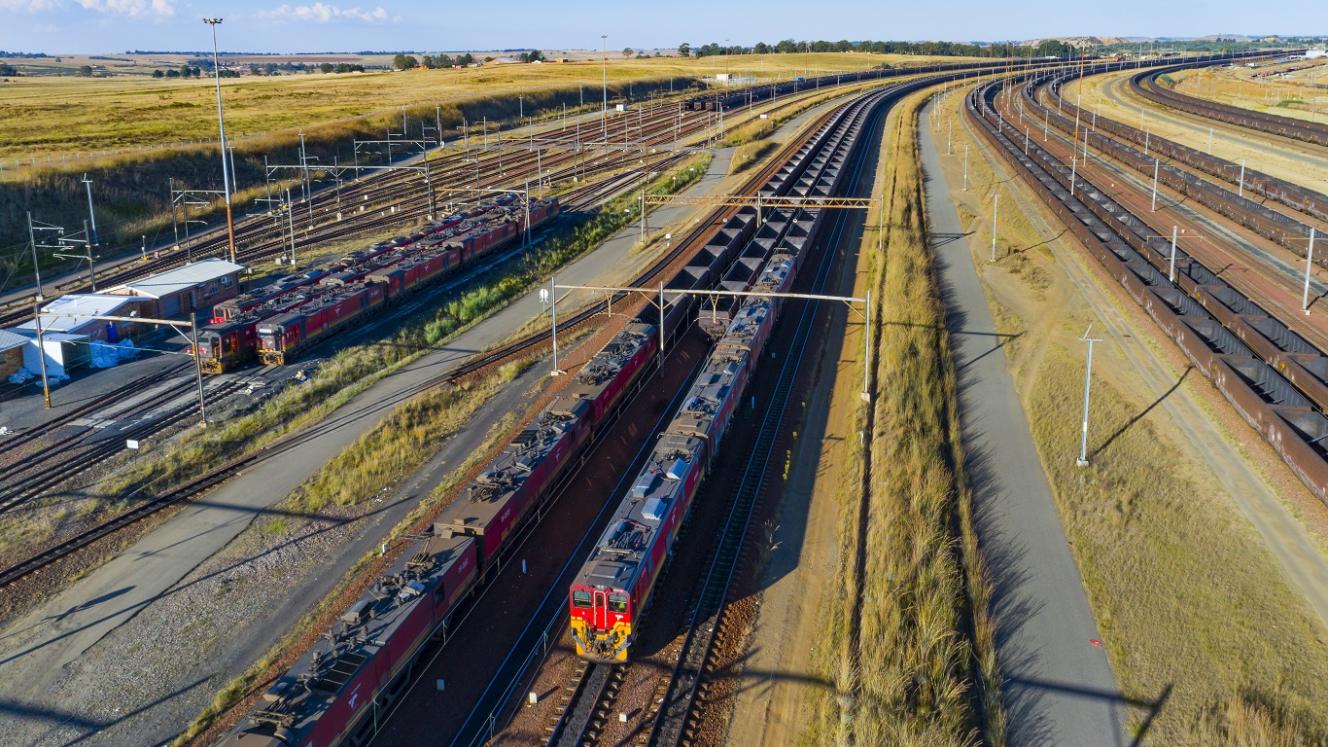
RAY SMUTS SOUTH AFRICA’S deck of trading cards has been thoroughly reshuffled, with Asian players on a winning streak from which there would seem to be no respite. Economists don’t believe South Africa is turning its back on traditional partners. On the contrary, they agree that the UK and European member state countries will always fulfil an important role in trade. For now, however, all eyes remain firmly locked on Asia, China and India in particular, expected to be the dominant players before the first quarter of this century is out. China, the world’s fourth largest economy, registered growth of 11.3% in the first quarter of this year, the highest in a decade. The importance of Asia as a trading bloc cannot be sufficiently underscored given that 25% of South Africa’s total exports are bound for that continent, amounting to R91.6 billion in 2005, with overall imports of R96.5 billion the same year. Compare these statistics to six years ago (2000), when South Africa’s overall Asian imports stood at some R50 billion and imports at around R96.5 billion. These figures however need to be viewed with a degree of caution in that they are nominal rather than real figures, not taking into account inflation. Nevertheless they represent a hike of 14.7% or one-and-a-half times growth. Perusing South Africa’s total global trade by geographical region, Asia commands about 24%, EU member states some 38%, North America 10%, the Middle East around 8% and Africa almost 9%, although it must be acknowledged African exports to Asia have been growing at 10% annually – higher than elsewhere in the world. Easy business partner Western Cape Investment and Trade Promotion agency (Wesgro) economist in the global business intelligence unit, Riefqah Jappie, says Asia has without question grown significantly faster than Europe and the US. And government has made it easier for South Africans to conduct business on that vast, in some respects still unknown continent. “That is not to say we should forget our traditional markets like Europe. They will always be key, stable, markets, in some ways easier for us to enter.” Jappie holds the view that a shift in export markets is likely in the next few years, China probably overtaking Japan (See page 3). “The big trend in some of the Asian countries is either toward automotive or commodity-related products. One of our challenges is that we are becoming a source for the major manufacturing industries of Asia and that is dangerous. “Our export basket is not diversified. We are not adding much value here and concentrating instead on traditional exports like metals, food and wine.” Jappie illustrates by way of example that South Africa exports to Japan platinum, wood and alloys while it imports finished goods. “At the moment we are fortunate that commodity prices are strong, but when that changes you are going to have to sell more commodities for one earth-moving vehicle.” She believes it essential that South African business should not view Asia as one single market. “This is not so and we should get rid of the notion that paradise awaits out there.” Jappie draws the analogy between a mature Japan market with high standards while populous China, with its low per capita income, is still very poor in the western and inland regions. Also to be borne in mind is that within Asia there is a huge diversity of religions, cultures and peoples, a continent where no two trades are alike. “I have heard the Japanese do not regard themselves as Asian, Chinese and Malaysians would not consider themselves the same, nor would the Indians and Pakistanis, so we in South Africa have to be very careful not to paint everyone with the same brush stroke.” Her advice for those contemplating entering Asia markets is: • Start slowly • Take each market separately and tailor each product to suit a specific market in a specific country. • Bear in mind there is a huge range of markets in each country Michael Jones, senior consultant at The Beijing Axis in Beijing, China, said in reference to the state visit by Chinese premier, Wen Jiabao, to South Africa in June that both nations were going to “great lengths” to regain the momentum in developing relations that saw a high between 1998 and 2004, cooling somewhat thereafter. Even though the Chinese have agreed to reduce the flood of cheap textiles, which has cost this country thousands of jobs, the Western Cape in particular, Jones says trade between the two countries remains unbalanced in China’s favour, a situation likely to persist in the near and medium term at best. “South Africa’s problem remains that raw materials dominate its exports while imports from China, though benefiting the man in the street through lower consumer product prices, affect a multitude of local industries, resulting in job losses.” Jones, in reference to China’s rapid expansion in Africa, warns: “Unless we increase our engagement with China we will render ourselves irrelevant and future visits by the Chinese leadership will be reduced to mere courtesy calls.” Jones, formerly of Somerset West, is convinced if South Africa does not become a meaningful partner with China within the next decade or so, it will have “lost out to a zero-sum game.”
SA needs to add value to commodity-based exports
Comments | 0
© Now Media. This content is protected by copyright and may not be adapted or republished. If you would like to discuss cooperation opportunities, please contact: editor@freightnews.co.za.