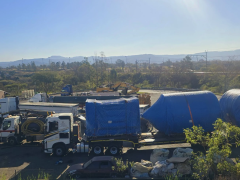
Being able to offer both rail and road transport to customers provides a competitive advantage, says Raj Maistry, CEO of JVC Freight. “Road is obviously faster but companies will always decide the mode of transport based on their convenience and also service requirements” He says being able to meet these requirements is essential despite better control of transit times using road. “We find that when there are no KPIs to meet or when there have been heavy losses on road, customers tend to want to use rail. Insurance companies who have also seen major claims on road tend to sometimes prescribe rail as well. Through our investment in CMKCD we can offer both road and rail as an option,” says Maistry. “There are challenges on both road and rail. Overcoming those challenges is what makes for successful business.” On road issues to be dealt with include the limited working hours of depots in Johannesburg. “We need the depots to be open at least until 10pm on weekdays and 4pm on a Saturday. The other challenges we face include the rising diesel costs, the new toll fees in Gauteng, and also the fact that there are so few safe places for trucks to park so that drivers can take a rest.” Rail, on the other hand, faces serious capacity constraints while derailments and congestion at City Deep in Johannesburg continue to be challenging. Having recently partnered with a transporter, JVC Freight is now also in a position to offer gensets for the transport of reefer containers. “Part of the equipment consist of 17 by 12 metre high cube trailers that accommodate a gross weight of 32 tons,” says Maistry. “These trailers meet with the height restriction as prescribed by the Department of Transport.” All drivers have been trained to handle reefer containers, cargo and equipment, while the shipping lines have approved the gensets. “The reefer containers are delivered directly to the importer, avoiding the cold stores in Durban, which is a major cost saving,” says Maistry.
Road/rail mix serves customers’ varying needs
Comments | 0
© Now Media. This content is protected by copyright and may not be adapted or republished. If you would like to discuss cooperation opportunities, please contact: editor@freightnews.co.za.