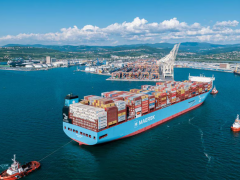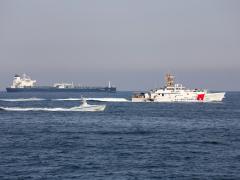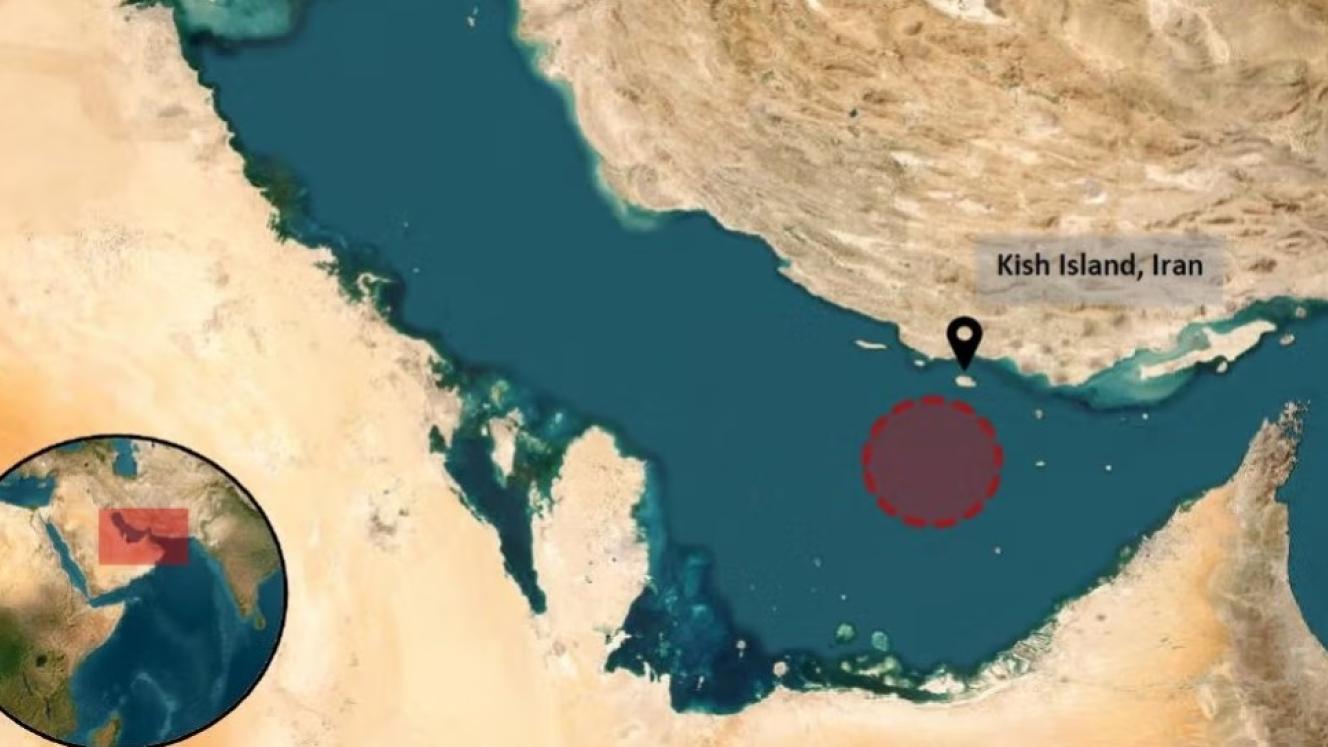
While ‘non-hostile’ commercial vessels have been trickling through the conflict-constricted Strait of Hormuz after Iran indicated ‘safe passage’ to diplomatic allies, risk has again risen well into the red after a box ship was struck by a projectile.
Although the flag affiliation or registry of the carrier was unconfirmed by Tuesday afternoon, its trajectory close to Iran’s Persian Gulf coast indicates that it may be non-hostile to Iran.
United Kingdom Maritime Trade Operations (UKMTO) reported that the vessel had been struck by an unknown projectile about 25 nautical miles (46.3 km) south of Kish Island, 45 minutes after midnight on April 7.
According to UKMTO, the vessel was struck just above the waterline with no visible hull breaching, no environmental impact and no reported injuries or fatalities.
UKMTO indicates that, as of February 28 when the US and Israel went to war against Iran, 27 maritime vessel incidents have been reported in the Persian Gulf and the Strait.
In a developing incident, it has been reported by Trade Winds that a container ship that had been abandoned after catching fire because of an Iranian attack, has sunk.
The site reports that, “the Pakistani division of the navigational warning service, Navarea IX, confirmed that the 1 740-teu Safeen Prestige sank while it was 6.5 nautical miles north-east of Ras Madrakah.”
“Navarea IX put the depth of the sunken ship at 120 metres, and cautioned mariners to beware of container remnants and oil spills in the area” it had reached, despite being badly damaged.
Latest developments coming out of the war-torn area, illustrate the extreme danger persisting in the Persian Gulf, extending into the Gulf of Oman and Arabian Sea, where the Safeen Prestige sank.
US security analysts and UK consultancy Windward have consistently warned that, despite Iranian invitations that non-hostile vessels could sail through the Strait provided they met certain requirements, sailing in the area remains extremely volatile.
Misidentification by Iranian authorities, for one, has been cited as a serious concern to carrier owners thinking it’s safe to sail through the Strait by skirting the Iranian coastline.
However, since Freight News first reported on March 19 that Iran had extended this invitation to vessels carrying cargo belonging to South Africa, reiterated by Mansour Shakib Mehr of the United Ulama Council of South Africa in Cape Town, the focus has again fallen on keeping supply chain flowing through the Strait.
This was stressed by Chris Hattingh of the Centre for Risk Analysis.
In an interview on eNCA on Sunday, he said “fertiliser inputs” not moving through the Strait could seriously impact South Africa’s agricultural sector.
Of the more or less 80% phosphates and nitrogen that South Africa imports for fertiliser production, the lion’s share come from Gulf Cooperation Countries (GCC) such as Saudi Arabia, Qatar, Oman and the United Arab Emirates.
The latest data by Global Sovereign Advisory has found that 87% of the ammonia used to mix with phosphoric acid for fertiliser production is imported from the GCC to the Port of Richards Bay.