Recently retired managing
director of DAL Agency SA,
Ron Frick, recalls ”C-Day”,
July 1 1977, being celebrated
with fanfare at all the newly
constructed container terminals in
Durban, Port Elizabeth, Cape Town
and the dedicated inland port of
Johannesburg.
The are his reflections 40 years
later...
Q. In retrospect, did
containerisation deliver what was
expected and did it achieve its
mandate?
Certainly the introduction of the
container was conceptualised for
South African local conditions; it
was a well-planned well thought out
concept, following processes in the
rest of the world. In terms of reefer
capacity, SAECS with its “Conair”
containers followed the Australia/
New Zealand container model, which
was very successful at the time.
Q. What were the biggest issues?
As with any new system there were
minor issues but in retrospect
everything worked out remarkably
well from the container packing
inland to the efficient inland rail
service that operated at the time,
bringing both LCL and FCL
containers to City Deep and other
inland destinations for unpacking
and packing.
Q. What has been the biggest
change over the past 40 years in
the industry, did you ever conceive
of the size of biggest container
vessels currently on the waters?
The biggest change has been
the massive industrialisation in
China and Asia, with Western
nations outsourcing much of their
industrialised production to Asia, to
benefit from economies of scale. This
led to a huge increase in demand for
East-West shipping space.
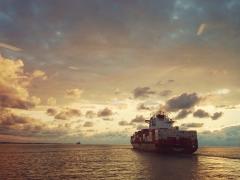
Global carriers responded by
building ever larger vessels and the
race began amongst the carriers to
achieve the cheapest slot price per
container - hoping to remain in a
dominant market share position.
This also led to irresponsible
lending by major banks to finance
the construction of the very large
container vessels.
2008 was a turning point, where
international trade contracted and
the orders place for new container
tonnage far exceeded space demand,
leading to the overall collapse of sea
freight rates internationally.
Q. Over the past years lines have
complained that freight rates are
not sustainable, and rates seem to
go down every year as costs go up.
What of the future?
The realistic answer is certainly
yes, the current freight levels are
not sustainable; which shareholder,
in their right mind, would operate
a business at a loss? This is the
position of many carriers today,
particularly on the East-West trades
where cargo is transported at below
operating costs. Carriers are doing
what they can to reduce input costs
such as slow steaming to reduce
fuel consumed, computerising and
mechanising many of the functions
both at sea and on land, reducing
headcount and moving the service of
documentation to doc centres such
as India and other Asian centres of
excellence.
Despite all these measures the
competition remains severe whilst
costs continue to escalate and only
the lines with the deepest pockets
will ultimately survive. The smaller
carriers will need to consolidate with
other smaller lines or be bought out
by the bigger carrier as we saw with
Hamburg Süd, being sold to Maersk
Line. Others such as Hanjin Line
have failed and filed for liquidation.
Competition has always been there
but not to the loss-making scale we
see today.
What will the future hold? In
my opinion there will be further
consolidation and rationalisation
amongst the various lines, if they
are to survive the future. The
control bodies – particularly in
Europe and the US – are placing
ever more environmental
demands on the carriers for
“green” compliance, and
safety of vessels at sea. All these
environmental demands place an
additional burden on owners in
terms of operating costs which
cannot always be recovered from the
merchants. It will be the survival
of the fittest lines who do not
compromise on customer service
levels. There will always be a place
for the niche operator who operates
below the radar of the global carriers,
meeting specific client needs, but
they are very insignificant in global
terms.
Lastly the development and
introduction of autonomously driven
cargo ships will
also have a
significant
impact on
the way
ships
operate
today.
Ron Frick