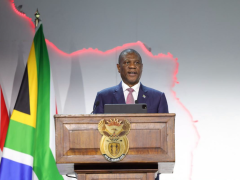
Minister of Energy, Jeff Radebe, last week conceded that South Africa’s refineries were currently not able to produce the cleaner fuels needed to enable ships and trucks to adhere to minimum emission standards.
Addressing media ahead of his Budget vote last week, he said investment in improving South Africa’s refinery assets, as well as the development of infrastructure required to transport natural gas and liquefied natural gas (LNG), were of “paramount importance” if the country was to meet higher global emission standards by 2020.
Radebe told journalists he would be consulting with “major players” in the fuel sector about a new refinery, highlighting too that the LNG gas reserves in neighbouring Mozambique’s Rovuma Basin provided an opportunity for the country to benefit.
“South Africa needs to develop an infrastructure programme to allow for the beneficiation of gas resources,” he said. Radebe emphasised the need for South Africa to prioritise gas – whether imported via pipelines or LNG port terminals – as it played a “vital role” in the country’s transition to a low-carbon economy and would ultimately bring down certain costs associated with the transport of goods – particularly with the carbon tax implementation date looming.
Economists such as Mike Schussler have already warned of the impact of a carbon tax on South Africa’s transport economy while World Wildlife Fund for Nature’s head of policy, Salim Fakier, said that due to its heavy dependence on coal, SA was one of the world’s most carbonintensive economies. He said the carbon tax was an economy-wide driver, incentivising lowcarbon options.
A spokesperson for the International Maritime Organisation (IMO) – which has set a global bunker fuel sulphur cap of 0.5% by 2020 – told FTW the organisation was “pleased to hear” that refineries were preparing to bring the required new fuels to the market to meet the sulphur 2020 limit.
“IMO provides the forum for everyone who will be involved with this issue to raise concerns and provide input into the guidance which is being developed. This includes refineries and the industry which is represented at IMO through the relevant non-governmental organisations,” she said.
INSERT
South Africa needs to develop an infrastructure programme to allow for the beneficiation of gas resources. – Jeff Radebe