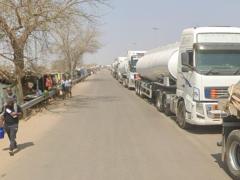
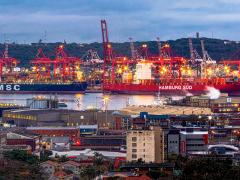
Shallow port demands ship to barge operation JOY ORLEK SDV HAS more than doubled its project division staff since September last year – an indication of the company’s growing market dominance, says project manager Caroline Brownson. The two major areas of focus at the moment are the QMM Ilmenite mineral sands project in Madagascar and the Tenke Fungurume project in the DRC, both of which bring their own set of challenges, says Brownson. On the QMM project, which involves the construction of a plant to extract mineral sands, 70% of the cargo is sourced from SA with 30% moving in from Australia, China and Europe. “Because the project is in Fort Dauphine south of Madagascar where the depth of the port is too shallow for seagoing vessels, we’re routing cargo from Durban to Tulear on a seagoing vessel and from Tulear to Fort Dauphine by barge,” says Brownson. Among the bigger pieces shipped were 16 pontoons from Nan Tong ranging in size from 60-125 tons. “The biggest challenge is the ship to barge operation,” she told FTW, with cyclone-prone Madagascar adding weather challenges to the equation. The project is well under way having started last November, and due for completion in 14 months. As an indication of its size, it requires six dedicated staff members. SDV has also recently started work on the Tenke Fungurume project which involves the construction of a copper mine in the DRC. Once again the majority (60%) of the cargo is sourced in South Africa, moving by road to the DRC. The remaining 40% is routed through Durban, Richards Bay and Walvis Bay. “We’ve sent a few loads already but will start in earnest in 4-6 weeks time,” says Brownson, with completion date scheduled for 18 months time. Smaller projects are also under way in Senegal, Mali, Burkina Faso and Tanzania. “Our SDV infrastructure in Africa works well for us,” says Brownson. “We offer a door to door service unlike a number of our competitors who are working through agents rather than own offices. SDV is present in 42 African countries, with 220 agencies employing more than 30 000 full time and casual workers. “Our projects division is essentially a company within a company. Specialised people handle the construction phase, the supply contracts, as well as road, sea and air, with a dedicated airfreight division that handles only project cargo.”
Project division doubles to cope with growing business
Comments | 0
© Now Media. This content is protected by copyright and may not be adapted or republished. If you would like to discuss cooperation opportunities, please contact: editor@freightnews.co.za.