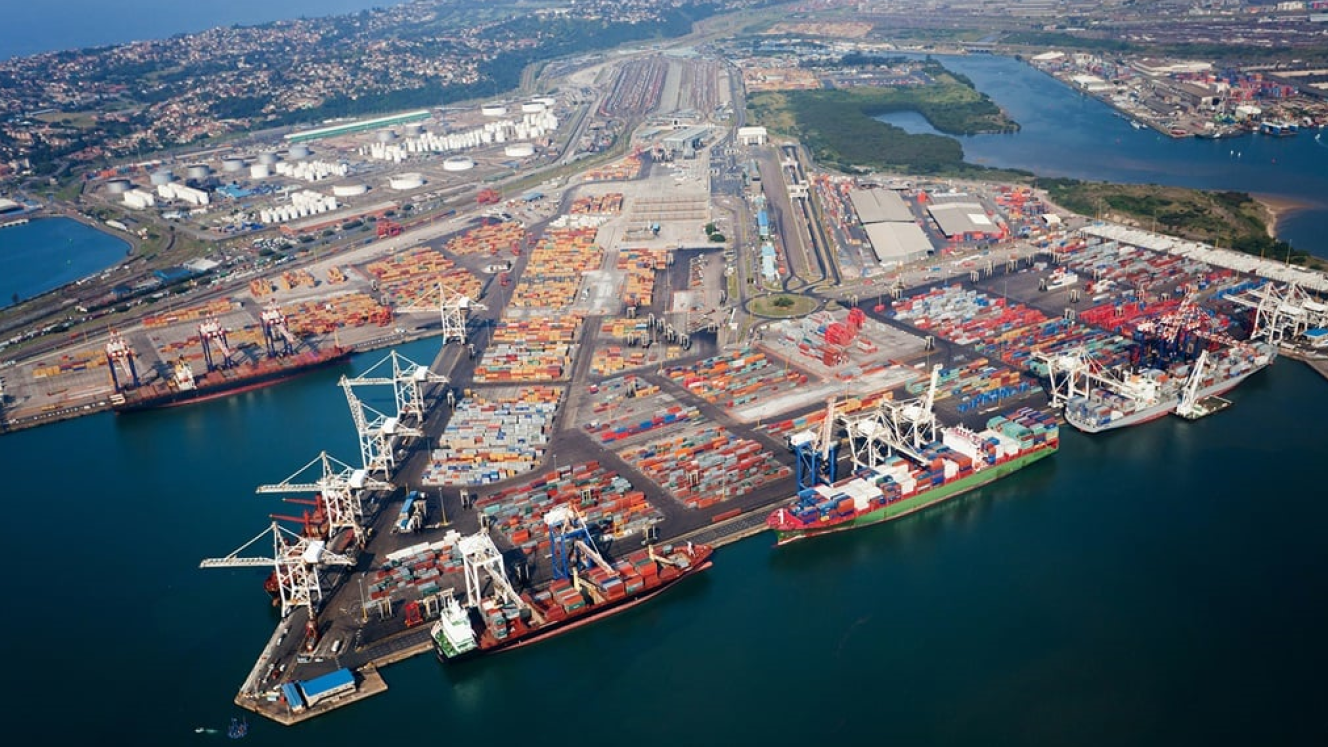
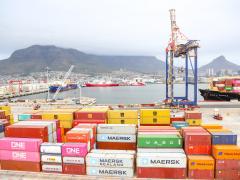
THERE ARE now visible signs of some of the latest developments at the Port of Durban – with short-, medium- and long-term projects taking shape all around the harbour area. To give us a personal view of this activity, Transnet National Ports Authority (TNPA) recently provided a 2-hour guided tour in their corporate craft, Isiponono, for FTW journalists. The first, and probably most visually noticeable project, was the widening and deepening of the harbour entrance – a dredging, demolition and reconstruction programme which will open the Port of Durban up to container ships of up to 9 200-teu capacity, and similarly larger bulk and breakbulk vessels. At the harbour end of the cut mouth a whole area that was occupied by warehouses, workshops, offices and pubs has been completely flattened. And, to line-up the entry channel with the new breakwater – which is 150-metres further north than the current one, and already poking its finger out into the Indian Ocean – the previous tug jetty, for example, is being cut into removable blocks by a large, revolving diamond-edged cutter. The overall exercise will effectively widen the actual approach channel by 90-m, according to deputy port engineer, Dave Ward – and allow for a draught depth of 19-m in the entrance, reducing to 18-m at the inner end; and 17-m reducing to a final 16-m on the approach to the harbour’s container terminals. Another visible sign is the large Belgian dredger which has been hired to deepen the entry channel – and has already suckedup three-million cubic metres of the seven-cu m that have to be dredged. The new Pier 1 container terminal, which adds its 720 000-teus a year capacity to that of the present Durban container terminal (DCT), is also now a busy, bustling operation. According to our other port engineer guide, David McGillewie, Pier 1 now has its 18 rubber tyre gantries (RTGs) all in full operation, and five of its ship-to-shore gantry cranes up-andrunning with a sixth due for delivery in December. “It was a three phase completion,” he added, “with the handover of Berth 105 and its back-up areas on June 19; 106 and backup on September 6; and 107 on October 4. “It’s now in full-swing.” Something else which might change the face of the port, according to TNPA’s acting manager, planning and development, Selvan Pillay, is a plan being considered by Transnet Pipelines. “The pump station for the current fuel pipeline from Durban to Gauteng is in the port at Island View,” he said, “and is linked to the various operations which use it to move their fuel up to the Reef – like Engen, Sapref, Sasol and BP.” The latest proposal from Transnet Pipelines, he added, will have a new, full-scale fuel terminal and tanks connected to the suppliers. But they are still investigating whether it will be situated in Island View, or moved to a new site at the Durban International Airport – due to be shut down in 2010, when the new King Shaka Airport opens at La Mercy on the KZN north coast. If they decide to move it, according to Pillay, it would reduce the number of rather ugly fuel tanks in the port area.
Port of Durban on the move
Comments | 0
© Now Media. This content is protected by copyright and may not be adapted or republished. If you would like to discuss cooperation opportunities, please contact: editor@freightnews.co.za.