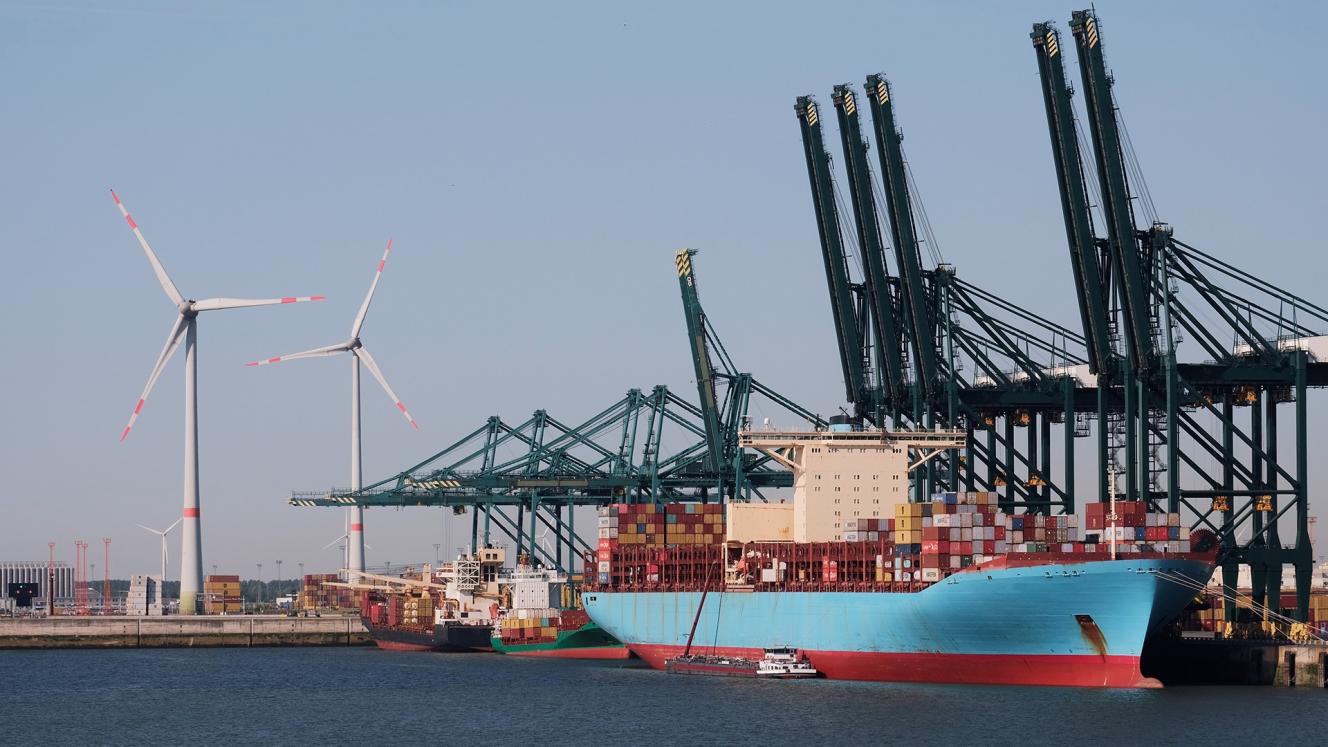
Port congestion was tying up about 1.85 million TEUs of container ship capacity in late August as Red Sea diversions added further pressure to global shipping networks.
In a market update published on August 21, Kuehne+Nagel said 4.55% of global container vessel capacity was waiting outside the 45 ports monitored by its seaexplorer Anchorage Congestion Indicator.
The queues are effectively removing usable vessel capacity from the market, contributing to longer lead times, unreliable schedules and greater uncertainty for shippers.
Strong export demand from Asia, particularly China, is placing renewed pressure on global container flows. Terminals and inland transport networks are struggling to absorb higher and increasingly imbalanced cargo volumes, according to the update.
Congestion is affecting major gateways in Northern Europe, China, Brazil, West Africa and India.
The main constraint was no longer the supply of vessels, but the limited capacity of ports and inland transport networks to handle rising volumes efficiently, Maersk CEO Vincent Clerc said.
Terminal, rail and trucking capacity cannot be expanded quickly, increasing the likelihood of recurring bottlenecks and volatile freight rates, he added.
Geopolitical uncertainty in the Middle East is adding further pressure. Security risks in the Red Sea and Bab el-Mandeb have kept many vessels on the longer route around the Cape of Good Hope.
Uncertainty around the Strait of Hormuz has also raised bunker costs, making Cape diversions more expensive, Kuehne+Nagel said.
The longer Cape route increases fuel consumption and voyage times, absorbing capacity that would otherwise be available in normal shipping rotations, Kuehne+Nagel said.
Higher bunker costs were making the shorter Suez Canal route increasingly attractive to carriers, despite the continuing security and insurance risks in the Red Sea, the company added.
Port congestion alone may not be sufficient to keep freight rates elevated over the longer term, according to Xeneta chief analyst Peter Sand, whose assessment was cited in the Kuehne+Nagel update. He regarded disruption in the Red Sea as the more significant factor affecting available capacity and freight rates.
A normalisation of Red Sea sailings would release capacity currently absorbed by longer Cape diversions, Vespucci Maritime CEO Lars Jensen was cited as saying.
Shorter transit times, combined with deliveries from the large container vessel order book, could move the market from constrained supply towards overcapacity, the analysts cautioned.