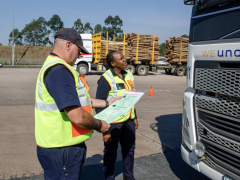
Unless strict security is in place, air cargo is extremely vulnerable at every handling point, an easy target for both the criminal elements and terrorists. According to a special study of airfreight security prepared for FTW by Rob Garbett, chairman of the Business Aviation Association of Southern Africa (Baasa), this is where Part 108 of the SA Civil Aviation Authority (CAA) regulations – based on International Civil Aviation Organisation (Icao) and International Air Transport Association (Iata) practices – plays a vital security role. The risk varies in intensity from point to point along the cargo’s route, said Garbett, but equally, Part 108 varies in accordance with this. The likelihood of theft at the premises of the consignor is assessed as “slight”. However, the possibility of introduction of explosive material at the consignor should not be disregarded. Then the security of cargo moving from the consignor to the forwarding agent – or, in some cases, directly to the air carrier – is dependent on whether or not the consignor uses its own transport or a service provider. The former, theoretically, is the more secure. The most important add-on security during this sector of movement is whether or not the consignor is a “known consignor” under Part 108. The consignor – if compliant with the Part 108 system – must adhere to the security aspects embedded there. This includes the sealing of vehicles, which must remain intact and recorded, and can only be broken by the forwarding agent. Violation of this procedure will cause an alert. It also requires that the driver and vehicle assistant have a certain level of formal training and are background-checked at regular intervals. “Whilst in the hands of the forwarding, or courier, agent,” said Garbett, “air cargo is more vulnerable to interference if the forwarding or courier agent is not a “regulated agent” under Part 108. “The procedures and systems in the regulations tighten up all round security which, again, includes training and background checks and, perhaps most importantly, tight systems. “It should be noted that, during the movement of the air cargo from the forwarding or courier agent, it is more vulnerable to theft, or other interference, if that agent does not fall under the secure umbrella provided by Part 108. “Cargo delivered to the air carrier within a secure process remains secure until seals on the vehicle transporting the cargo are broken at the air carrier premises.” The whole perilous journey from the consignor to its destination is vulnerable, because the freight is in the hands of third parties – the handling agent, air carrier, transit point handling agents, and those in the processing procedures at destination. “Known cargo has a somewhat lower degree of risk during this process from consignor to the consignee,” Garbett told FTW, “as it is clearly marked and, in most instances certainly, more attention is paid to the sealing of known cargo by the consignor and forwarding agents than is the case with unknown cargo – which is processed to become “known” by the air carrier.” Also, transit points present their own degree of vulnerability – depending on the particular transit point through which the cargo moves, he added. CAPTION The whole perilous journey from the consignor to its destination is vulnerable, because the freight is in the hands of third parties.
Part 108 plays vital security role
Comments | 0
© Now Media. This content is protected by copyright and may not be adapted or republished. If you would like to discuss cooperation opportunities, please contact: editor@freightnews.co.za.