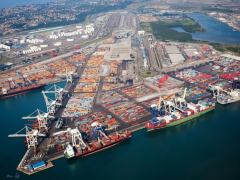
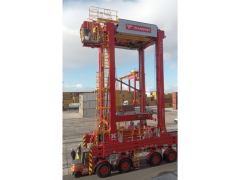
An answer to a problem that has been plaguing both the shipping and the road transport industries – the curse of overweight containers, and the safety hazard they present – may soon be found. FTW was first alerted to this potential solution in an e-mail from a reader. Responding to an article headlined ‘Weight misdeclaration remains a thorny issue for carriers’ (FTW – May 29, 2009), he said: “Surely the logical solution is to straddle-weigh containers in the terminal. “The current generation of straddles is reportedly fitted with weighing devices, enabling the all-up weights (container and contents) to be established. “The problem is to get Transnet Port Terminals (TPT) to activate/use the facility for the benefit of all concerned.” An FTW investigation revealed that this idea originated with the Durban truckers’ division of the SA Association of Freight Forwarders (Saaff), and was one that they had been proposing to the port terminal management for some time. Said Kevin Martin, MD of Freightliner and vicechairman of the Durban Harbour Carriers Association: “This is something we’ve put to TPT on a number of occasions. “It seems only sense that – as they have these weighing devices fitted to all the latest straddle carriers – they should link this weight measurement to the documentation in their system.” And the declared weight of each and every container – either import or export – is already in the system. “The booking reference and the declared container mass must be in the system before anybody can pick up the box,” said Martin. “At the other end, you have this weighing device. But the two never meet, because, according to TPT, they can’t interface this mass with the documentation.” But, he added, with the port terminals having their new computer system, Navis, in the offing, surely these two vital checkpoints could be connected. The measuring system certainly couldn’t be used by shipping lines to impose a penalty charge for the actual amount overweight. “You’d need an assized weighbridge before you could invoice for a verified overweight container,” said Martin. “The machines are not that accurate. “But they could certainly show which boxes are seriously overweight – and this would be a major safety contribution for the road trucking and shipping industries.” The good news discovered by FTW, is that the port authorities have actually heeded this call, and are currently working on a plan to be able to introduce this vital cross-check of actual container mass against declared mass. TPT communications officer, Lunga Ngcobo, confirmed to FTW that straddle carriers are indeed fitted with appropriate weighing devices – intended to automatically trim the carrier to the load it has to lift. And, when queried about that missing link in the container mass/documentation communication chain, Ngcobo had only good news to tell us. The engineers designing the new Navis computer system, she told FTW, “are busy working on that very problem”.
Overweight containers – soon an issue of the past
Comments | 0
© Now Media. This content is protected by copyright and may not be adapted or republished. If you would like to discuss cooperation opportunities, please contact: editor@freightnews.co.za.