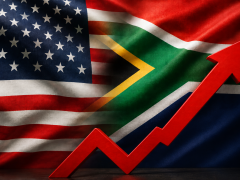
Brace yourself for a
downgrade.
That was the message from
Dawie Roodt, chief economist
of Efficient Group, following
President Jacob Zuma’s
cabinet reshuffle last week
that saw finance minister
Pravin Gordhan replaced
by previous home affairs
minister Malusi Gigaba.
“I don’t see any way
that we can prevent a
downgrade,” said Roodt.
“It is absolute state capture
and the goals have been
achieved. Those who wanted
to be are now in charge of
the South African coffers.”
The rand started to fall
when then finance minister
Pravin Gordhan was recalled
from an investment roadshow
in the UK ahead of the cabinet
reshuffle that cost him his job.
By early Friday morning it had
moved from R12.80 to the US
dollar to R13.60 and the by
the time of going to press it
was hovering around R13.54.
“State capture means
more incompetence, more bad
management, more
weak economic growth,
more unemployment,”
said Roodt. “The picture is
incredibly gloomy.”
Economist Mike Schüssler
said the appointment of
Malusi Gigaba as finance
minister would do little to
calm the market.
“He has no business or
finance credentials but he
does have strong links to the
Guptas,” said Schüssler. “He
has denied the allegations
around him and the Guptas,
but I don’t think that is going
to hold much ground in the
market.”
He said Gigaba’s track
record was insipid at best.
As Minister of Public
Enterprises it was under his
watch that SAA chair Dudu
Myeni was appointed – with
SAA performing worse than
ever before – while Eskom
awarded a contract worth
more than R564 million to a
coal mining company owned
by the Guptas. The visa fiasco
implemented during his
tenure as minister of home
affairs cost South Africa
millions in lost revenue. He
is a minister also depicted as
being stubborn and arrogant.
“The fact of the matter
is it is not really about
Gigaba or any other cabinet
appointments, but rather the
president,” said Schüssler.
“The running of the country
and the political decisionmaking
is causing massive
uncertainty which is affecting
the economic market
negatively. It is not as simple
as just the rand falling. That
was just the immediate
implication.”
A potential break-down
of fiscal discipline will
lead to a string of negative
consequences – including the
credit rating downgrade and
lower business confidence.
Interest rates will go up
and the government will have
less funds to service debt,
meaning less money to go
around for infrastructure,
transport, education, health
and so forth.
More worrying though
are the predictions that
this is just the start of the
president’s move to overhaul
National Treasury and a host
of other state institutions
including the Reserve Bank
and the government pension
fund.
“They are now in control
of one of the largest pension
funds in the world,” said
Schüssler.
“This is far from over,”
said Roodt. “Much of what
happens next politically will
depend on the outcome of
the motion of no confidence.
Before that process is
concluded it is very difficult
to predict anything.”
He said one certainty was,
however, the downgrade.
“It is not about if we get
downgraded any more but
rather whether it will be one
or two or even three notches.”
Save South Africa founder
Sipho Pityana said the
cabinet reshuffle was clearly
on behalf of the Gupta family
– an insult to the suffering
of millions of South Africans
over many decades, while
OUTA chairman Wayne
Duvenage said the personal
interests of one man were
now holding the people of
South Africa to ransom.
Along with other analysts
contacted by FTW, they agree
that Zuma has taken a huge
political risk – one that will
be at the cost of South Africa
and its economy if it pays off.