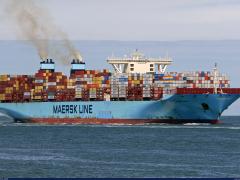
Never a ‘DAL’ moment... In an age of impersonal shipping giants, maritime journalist Judy Bryant charts the path of a family-owned shipping company that proudly retains the personal touch. The family group, headquartered in Hamburg, has African links both through its Deutsche Afrika Linien divisions (DAL, formerly DOAL) and the John T Essberger tanker division, whose vessels serve mostly Mediterranean, Baltic and North Sea ports. The organisation has connections that go right back to the early nineteenth century with a cast of players that includes war heroes and powerful, charming women. The story commences back in 1837 when German entrepreneur Carl Woermann registered his company C. Woermann & Co. in Hamburg. Twelve years later the first Woermann ship departed for West Africa. Within 30 years the fleet had grown to 35 sailing ships plying between Northern Europe and West African ports on the former Gold Coast and Nigeria carrying a variety of general cargo. The next Woermann generation benefited when Chancellor Bismarck passed a subsidy law in 1890 to establish a shipping line to serve the East African colonies. The contract was won by a consortium led by Carl Woermann’s son Adolph Woermann, who started up this new service as the Deutsche Ost-Afrika-Linie (DOAL). It initially ran from Hamburg to Delagoa Bay (Maputo) via Suez every eight weeks. Within two years the service was extended to Durban and in 1898 to Swakopmund in German South West Africa. Then at the turn of the century DOAL started a round Africa service, via Suez to East Africa, down to Cape Town and back to Hamburg. Woermann and Co. subsequently sold their shares and those of DOAL to the German state-owned Hapag Lloyd Union. At this chapter in the story one encounters the charismatic and entrepreneurial John T Essberger: A former officer in the elite German Imperial Navy and a torpedo boat commander, he founded, with fellow naval officers, a tanker shipping line in 1924. It grew rapidly into Germany’s largest private shipping line, boosted by the growth in road transport and the demand for liquid fuels. A British subject by birth, Essberger was a Hamburg councillor and chairman of the German Shipping Lines Association until 1941. Both promoted and opposed by the National Socialists – his second wife Elsa was the widow of Jewish fighter pilot Jacob Wolff, and he employed and did business with many Jewish colleagues – his closest friend was the head of counter-espionage, Admiral Wilhelm Canaris, who was later involved in the resistance against Hitler, arrested, and hanged. Essberger lost most of his vessels during World War 1, whilst Germany’s two major state-owned shipping companies, Hapag and North German Lloyd, were in dire straits. Following an expert report by Essberger (who succeeded in rebuilding his own fleet) only the transatlantic liners remained in state ownership. The remaining parts of both shipping line groups were broken up and privatised, taking on a new and profitable lease of life. In 1941 DOAL, part of Hapag and regarded as needing restructuring, was taken over by John T. Essberger and his friend the tobacco magnate, Reemtsma. Under John T Essberger, however, DOAL began a “meteoric rise and became a real goldmine for its owner” according to author Svante Domizlaff, who wrote a history of the tanker shipping dynasty. In 1959, after John T Essberger’s death, his daughter Liselotte von Rantzau- Essberger took over the Group. With the assistance of directors such as Prof. Rolf Stödter, also chairman of the German Shipping Lines Association for many years, there was strong growth in all the services operated to the African continent as well as the tanker division under the name John T Essberger, its founder. Mrs von Rantzau-Essberger was a powerful individual in the male-dominated shipping industry. She was a bridge builder in Africa and developed personal contacts with the presidents of South Africa, Mozambique, Zimbabwe, Malawi, Kenya and many other countries. Her father had shown an exemplary concern for the welfare of the staff, supported by his second wife Elsa, who as a young widow had been applauded in Hamburg for her beauty and wealth, and her skilful manoeuvring of her heavy Harley-Davidson motorbike on the frozen Alster city lake. Mrs von Rantzau, affectionately known as “Aunt Lilo”, continued this tradition, with company excursions and Christmas and summer festivities for staff members and pensioners. Every employee received a turkey at Christmas while the children were invited to a fairytale performance at the Altona Theatre. The Group met the challenges of adapting to a totally new form of transport, namely containerisation, but in the 1970s trade to Africa began to deteriorate. Many countries in West Africa were ravaged by civil war and resultant economic chaos. Economic sanctions on South Africa made an impact. DAL – Deutsche Afrika Linien –became a member of the SAECS consortium and together with its partners Safmarine, P&O, Nedlloyd and later Maersk, began to operate weekly services with fully cellular container ships from 1977 onwards to all the main ports of South Africa. Liselotte von Rantzau died in 1993 of complications following a heart attack. About 3000 people from all walks of life were present at her funeral and South Africa’s ambassador to the European Community, Neil van Heerden, spoke on behalf of President FW de Klerk. Total responsibility for the running of the organisation is now in the hands of two of her three sons, Dr Eberhart and Heinrich von Rantzau. Both men have been groomed at leading universities and corporations to steer the group through the choppy waters of modern fleet management. Heinrich von Rantzau, born in 1944, studied law at Munich, Freiburg and Hamburg universities. He gained practical shipping experience in South Africa, the UK and the USA, as well as additional training with Mobil Oil, Lykes Bros. and OOCL. His younger brother Eberhart became a reserve lieutenant in the Federal German Navy, temporarily assigned to a destroyer, like his grandfather John T Essberger. He studied business management in Bonn and Hamburg, obtaining his doctorate, and notched up practical experience at various French, British and American shipping companies and banks. Both brothers hold the position of managing director and run the company jointly. With the third generation now at the helm, the focus has been on further development of container services, bulk carrier operations, and chemicals shipping, which is being expanded and updated. A few years ago the Dutch chemical tanker company Broere Shipping was taken over and merged with John T Essberger’s own organisation. A fleet of chemical tankers (now in excess of 25) is operated mostly in the Baltic, North Sea and the Med. New vessels are on order at regular intervals to replace those that no longer meet the stringent safety requirements of the major liquid chemical shippers. DAL’s service to the Indian Ocean islands of Mauritius, Madagascar and Reunion via Suez from Europe was recently expanded when the company entered a much larger consortium known as NEMO of which the other partners are CMA/CGM. The service on a weekly basis serves ports in Northern Europe to the Indian Ocean islands and on to Australasia, the islands of the Pacific and back to Europe via Indonesia, India and the Middle East. The Western Mediterranean ports are serviced by DAL with a fully containerised service to and from southern Africa. Feeder vessels to and from Las Palmas connect with the main line SAECS service. Lastly DAL also has a 1700 teu vessel, in the so called Second String Service from Northern Europe to South Africa. This is operated jointly with other SAECS partners and serves East London as well as Durban, Port Elizabeth and Cape Town. The fully cellular container vessel (4500 teu) DAL Kalahari employed in the main SAECS service is currently the only vessel which can accommodate passengers between South Africa and the UK/Europe. It is very popular with the older generation who well remember the regular mail service of the Union Castle Line some 30 years ago. This dynamic and constantly evolving group is well positioned to continue successfully, since Eberhart von Rantzau has a young son and daughter, and his brother Heinrich also has three sons, two of whom are currently being trained in all aspects of the ship owning and operating business. Thus the fourth generation of John T Essberger should ably steer the family’s fortunes well into the 21st century.
Never a ‘DAL’ moment...
Comments | 0
© Now Media. This content is protected by copyright and may not be adapted or republished. If you would like to discuss cooperation opportunities, please contact: editor@freightnews.co.za.