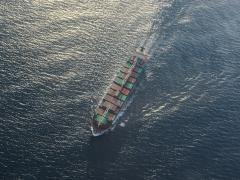
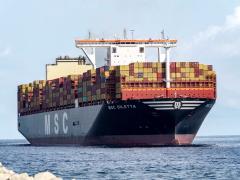
Significant shortfall possible in available money to pay claims ALAN PEAT IN THE case of the MSC Napoli, there are indications from the shipowner’s solicitors that a limitation fund could be established in the next few days, according to Andrew Robinson, director and maritime specialist at the Durban lawyers, Deneys Reitz. This, he added, means that “there will be a significant shortfall between the claims and the money available to pay those claims.” And, from Robinson’s own calculations, it could be as much as R200-million – or about half of the total expected claim of about R400-m. That is calculated from the shipowner’s liability being limited in terms of the provisions of the 1996 Protocol to the 1976 Convention on the Limitation of Liability for Maritime Claims, Robinson told FTW. “This Convention allows shipowners and charterers to limit their liability for property claims (whether brought in contract or in negligence) under a formula based on the tonnage of the ship multiplied by a fixed number of special drawing rights (SDRs) – the International Monetary Fund (IMF) unit of account determined daily.” Applying that to the MSC Napoli it is: * One million SDRs for the first 2 000-tonnes; * For each ton from 2 001 to 30 000 - 400 SDRs; and * For each ton beyond 30 000 - 300 SDRs.For the MSC Napoli,” said Robinson, “which is 53 409-t gross weight, the fund will be 18 222 700 SDRs. At the February 9 rate that will equate to US$27 190 800 (R194 .41-m). ”Losses are expected to be well in excess of R400-m – so, even if the weather allows a good proportion of the cargo to be salved, there will be a significant a shortfall between the claims and the money available to pay those claims.” In the first instance, the shipowner’s liability to cargo interests might be determined in accordance with the bill of lading (BoL) terms, if the shipowner is the contractual carrier, Robinson added. Most BoL terms allow the carrier to limit its liability in terms of the Hague-Visby Rules – which allows the carrier to limit its liability to either 666.67-SDRs [US$1000.00] per package, or 2-SDRs [US$3.00] per kilo of goods lost or damaged (whichever is the greater). “However,” said Robinson, “it is easier (in relative terms) to break the Hague-Visby limits applicable to bill of lading contracts than it is to break the overall limits imposed by the 1976 Limitation Convention. Where cargo has been carried against BoLs where the shipowner is not the contractual carrier (so-called “House” BoLs), then being able to break these limits will be significant as some of the House BoL carriers, who are not slot charterers, will not have the protection of the Limitation Convention.” “In summary, if a claim is subject to BoL limits, that limit must be determined first. It is that liability of the shipowner that goes forward to be considered, along with all other claims, for payment out of the fund. If the fund is insufficient to pay out the claims in full, the claims are further limited, pro rata.” It is not much use for claimants to hope that the shipowner will lose his right to limit. In terms of Article 4 of the 1976 Limitation Convention, this only happens “if it is proved that the loss resulted from its personal act or omission, committed with the intent to cause such loss, or recklessly and with knowledge that such loss would probably result.” “This,” said Robinson, “can be a tough onus for the cargo interest to discharge. “It follows that cargo claimants will need to consider how best to advance their claims, either in England or any other competent jurisdiction (such as SA) in order to secure the best possible recovery in the circumstances.”
Napoli shippers could face ‘limitation fund’
Comments | 0
© Now Media. This content is protected by copyright and may not be adapted or republished. If you would like to discuss cooperation opportunities, please contact: editor@freightnews.co.za.