With the advent of
larger container
vessels, ports
and terminals
are in the spotlight.
While no container vessels
with a TEU capacity of more
than 22 000 have yet been
ordered, studies have been
conducted into the feasibility of
24 000-TEU capacity vessels.
Addressing delegates at
Intermodal Africa in Cape
Town recently, Vishaal
Lutchman, divisional director
at the WSP Group, said now
more than ever terminal
planning was crucial as
container ports would have to
prepare to deal with these ultra
large next generation vessels.
“The next size of
container vessels could
result in significant capacity
redundancies at ports,” he
said. “There are even questions
about whether these vessels
will be a step too far.”
He said it was clear that the
capacity of container ships
would continue to grow, with
most lines now committed to
the next generation vessels.
China Shipping and MSC
have confirmed that current
orders are to be extended to
19 000 TEUs, while the 20 170-
TEU MOL Triumph is set to be
deployed in May this year.
Lutchmann said that other
lines were expected to follow
as the trend of the super-sized
vessel was here to stay even
though actual demand was
hardly justifying these much
larger vessels.
“Ports around the world
were sized to accommodate
for example the E class Maersk
(8000-14 000-TEU capacity)
when it was first introduced by
providing 16m of draught. This
also saw cranes upgraded to 22
rows,” said Luisman. “This was
extended to 23 cranes when the
Triple E Maersk was launched
with its capacity of 14 000 to
18 000 TEUs. No change
however was required for berth
or channel draughts.”
He said the increases
had been incremental and
that ports had been able to
accommodate and deliver the
necessary infrastructure to
handle these large vessels.
“The next generation
container vessel is another
thing altogether,” he said.
Shipping lines are
increasingly pushing for
vessels over 20 000 TEUs
as it allows for even further
cost savings than what have
already been achieved with
these mega ships. It is also
commonly accepted that if
one is building 18 000 TEU
capacity there remains no
reason not to push that
over the 20 000 TEU mark.
Technically there is nothing
hindering shipbuilders to
go to 24 000 TEUs.
“From a port perspective
this might be a step too
far,” said Luisman. “For
vessels over 22 500 TEU
draughts deeper than 16 m
will be required and cranes
would need 24 rows at
least.”
He said for 24 000-TEU
vessels there were two
options – either further
lengthening 430m quays
with a slightly deeper
draught or a shift to
broader vessels on a length
of up to 430m. This would
entail an additional row of
containers.
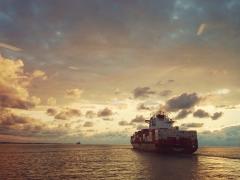
CAPTION
The 20 170 MOL Triumph … ports are having to prepare to deal with these ultra large next
generation vessels.
Mega-ships a headache for ports
Comments | 0
© Now Media. This content is protected by copyright and may not be adapted or republished. If you would like to discuss cooperation opportunities, please contact: editor@freightnews.co.za.