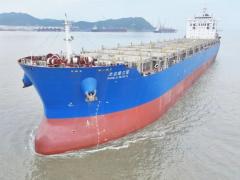
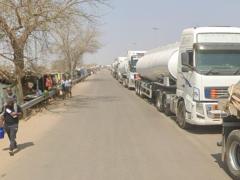
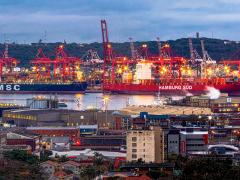
Walvis often preferred for southern Angola ED RICHARDSON MAERSK NAMIBIA is celebrating its 10th anniversary in the country with accelerated growth – and plenty of confidence in the future. “The rapid growth of the economies of Western Africa, notably Angola, is often underestimated,” says David Williams, managing director Maersk Namibia. The extent of the growth, including additional volumes from the P&O Nedlloyd acquisition, is evident in the number of Maersk transhipments through Walvis Bay. These have risen from 9 000 in 2005 to 40 000 TEUs in 2006. Most are destined for the West Coast of Africa. Maersk Logistics is also handling increasing volumes of cargo bound for Angola, Zambia and the Democratic Republic of Congo. With the exception of the declining fishing industry, the company is seeing growth in most sectors. A large percentage of the inbound traffic is destined for the border between Namibia and Angola north of Oshakati. “One of the interesting changes with regard to commercial imports over the past couple of years is that the portion sold to the Angolan retail market has all but disappeared with the vast majority now being sold to wholesalers,” he says. Visitors to the area find a thriving economy, with a Chinatown. Congestion and delays in the port of Luanda make Walvis Bay a preferred entry point for a certain sector of the southern Angolan market. “Angola is growing extremely fast – it is often difficult to keep up,” he says. Clients importing from the Far East have since April 2006 benefited from a direct service from Hong Kong and Tanjung Pelepas to Walvis Bay. The port is also served by direct Maersk services from Europe and South America. With a sailing time of just nine to 15 days from South America, manufacturers and suppliers on that continent are proving to be highly competitive in West Africa. “The key is the efficient handling of transhipments. They drive through benefits for everybody,” he says. Potential efficiencies in the port of Walvis Bay could help make up for delays in Luanda in particular, he adds. Although there is significant volume potential in the Gauteng area, the Trans Kalahari Corridor (TKC) has failed to attract significant volumes through Walvis Bay for a number of reasons. Williams says “a lot of lessons” have been learnt from the Trans Kalahari Corridor and these are being put to “good use” on the Trans Caprivi Corridor which provides an alternative to the ports of Dar es Salaam and Durban for Zambian and Democratic Republic of the Congo exporters.
Massive transhipment growth underscores West Africa potential
Comments | 0
© Now Media. This content is protected by copyright and may not be adapted or republished. If you would like to discuss cooperation opportunities, please contact: editor@freightnews.co.za.