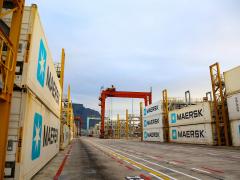
The impact of current global realities on the shipping industry is impossible to predict, but Safmarine’s Africa region executive Jonathan Horn expects global container trade growth of no more than 6-8% this year, with South Africa probably in the same ball park. “The realities are plain for all to see,” said Horn. “The two traditional engines of the world economy – the US and Europe – have some very serious challenges to tackle. And if you pull that thread through, those economies are high-consumption areas that drive production in the likes of the Far East manufacturing hubs such as China, Korea, Thailand – and that kicks back to the commodities trade in Africa which feeds that manufacturing cycle.” “We’re therefore unlikely to see double-digit trade in and out of South Africa this year as caution is exercised in terms of supply chains and inventories. “If you look outside of South Africa, the bulk of Africa’s economies are commoditiesbased and driven. China, with its burgeoning middle class and strong infrastructure development, will still have relatively strong growth fuelled by its own internal needs, but if the economies of Europe and the US move into a recessionary mode, South Africa could potentially head in the same direction.” Trade with Africa however remains an opportunity to be explored, in Horn’s view. “Africa has been delivering growth well above the global average – and with that growth comes an increased middle class.” While Horn concedes that the growth comes off a very low base, growth generates demand for goods and services. “Over time that means we will see much more inbound traffic of white goods, electronics, general retail merchandise, motor vehicles and the like.” During the recessionary period, the impact in West and East Africa was less evident and delayed compared to first world economies – and that was largely thanks to commodities. “But pure dependence on commodities is not a good thing for Africa in the long term – and while it’s great that we’ve got them, ultimately we need to add value before exporting. Over time, we must capture more of the value-add in Africa rather than handing this over to other economies.” According to Horn, there is some diversification happening, with manufacturing facilities being set up on a small scale for local or regional markets. What Africa needs, however, is labour-intensive industry to solve the key challenge of unemployment – for example industrial-scale agriculture, mining and basic manufacturing. What is also needed to get people to invest is institutional stability, greater predictability and investment incentives – a lot of which is starting to emerge, in his view. “Reliance on commodities can lull you into a false sense of security but it’s not sustainable. However, unless you can provide a value-competitive package, the opportunities to build value-adding facilities will be lost to other competing emerging economies.”
‘Labour-intensive industry is critical’
Comments | 0
© Now Media. This content is protected by copyright and may not be adapted or republished. If you would like to discuss cooperation opportunities, please contact: editor@freightnews.co.za.