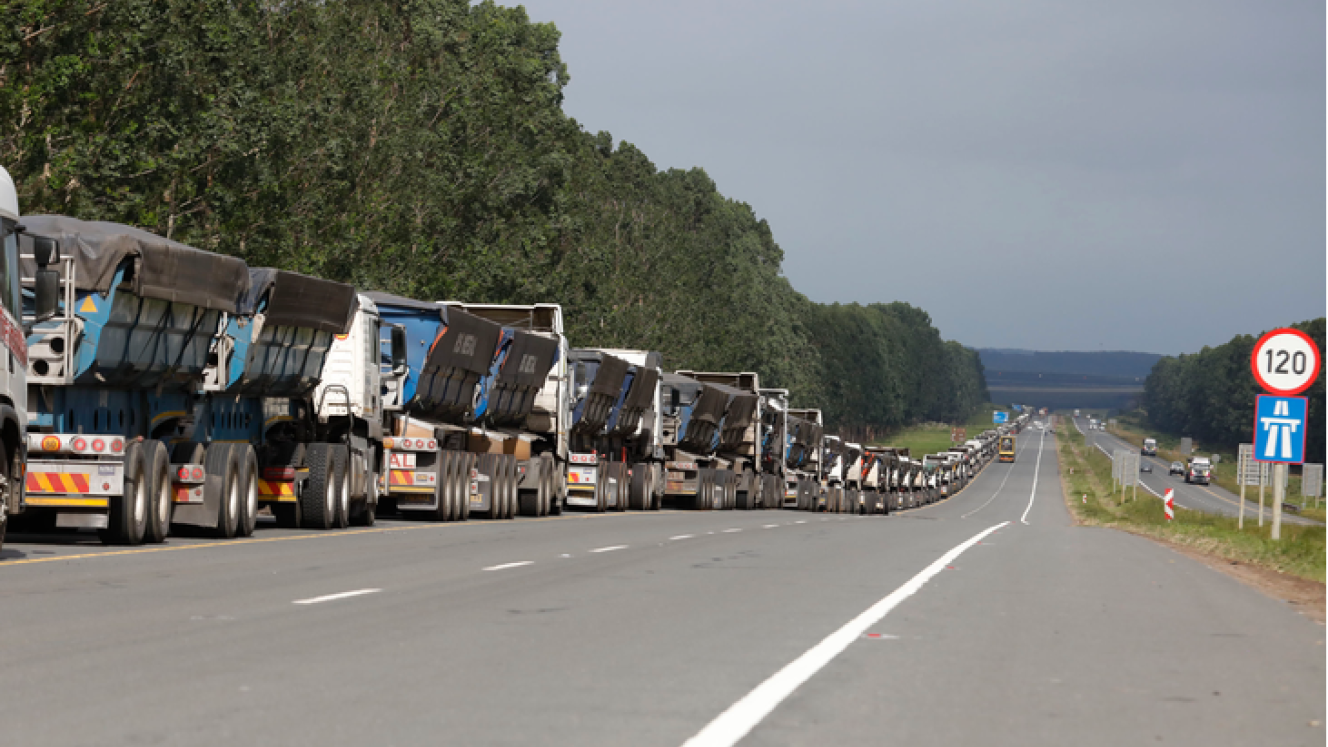
Long turnaround times, border inefficiencies and persistent congestion continue to undermine the competitiveness of southern Africa’s major trade routes, forcing transporters to rethink their operations on the region’s busiest corridors. According to 4PL Africa managing director Paul Cunliffe, these delays remain “killers for long-distance operators”, prompting the company to broaden its focus from the North/ South Corridor to include the Walvis Bay and Beira routes. “This has delivered mixed results, with speed and reliability still a major challenge,” he told Freight News. “It has subsequently led us to shift our sales focus away from bulk volumes towards more niche-type products that offer quicker, more predictable cycles.” The company has also upscaled its guaranteed express service on the North/South Corridor, extending its reach into mining areas in the north through additional capacity designed to avoid transhipments in Lusaka for onward deliveries. “Our established Zambian- registered business allows us the freedom to reload in these areas back into Lusaka,” he said. Cunliffe noted that the challenges faced by 4PL Africa mirrored wider systemic issues across the region’s trade routes, with delays on large shipments among the biggest obstacles. “Bad logistical planning results in over- congestion, both in and out, and it becomes incredibly difficult for operators to meet deadlines,” he explained. Corridor development in Africa remains inherently slow due to the multitude of interdependent levers that must align before a route becomes truly competitive. “Shipping lines need to call regularly, clients must become comfortable using the end port, ports must deliver consistently, and adequate space and infrastructure must be available for inbound and outbound traffic,” said Cunliffe. “Then volumes have to build to a critical mass of imports and exports to really make it work. All of this takes time.” From a South African perspective, Cunliffe believes the Maputo Corridor should receive far more attention. “Considering the catchment area it serves, the potential economic benefit is being lost due to long delays and border inefficiencies – issues that should not be difficult to resolve.” With growing demand for mining commodities in Zambia and the Democratic Republic of the Congo (DRC), interest in the corridors serving these countries remains high. “One of the most significant developments currently under way is the upgrade of the road between Lusaka and the Copperbelt, which is expected to have a meaningful impact on transit times across the corridor,” said Cunliffe. “There is a clear trend across Africa that once governments recognise the value of corridor development, it becomes easier for them to allocate resources. The Walvis Corridor is a perfect example. Their marketing team did a stellar job from the outset and it has really proven its worth. On the other hand, the N4 Maputo Corridor, which was launched long before, continues to struggle with a very dated border operation at Komatipoort that strangles the opportunity that was originally envisaged.” According to Cunliffe, as corridor efficiencies improve, transporters are likely to benefit from higher productivity. “Less congestion will deliver quicker turnaround times and ultimately lower costs for the end user. We remain hopeful that corridor developments will in time realise our dream of having efficient border crossings to ensure smooth passage along the routes. Transport is simple arithmetic. Transporters sell time and distance – reduce the time it takes to traverse a corridor, and you lower the cost to the consumer.” LV
Focus shifts from bulk to niche products
Comments | 0
© Now Media. This content is protected by copyright and may not be adapted or republished. If you would like to discuss cooperation opportunities, please contact: editor@freightnews.co.za.