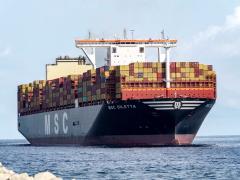
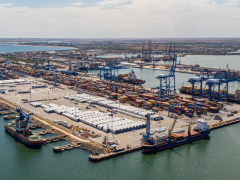
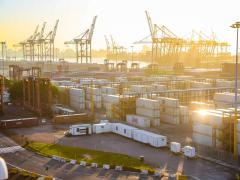
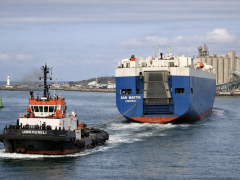
THE GROWING lack of multipurpose ships calling in Durban is forcing former breakbulk shippers into containerisation, whether they like it or not, according to Arun Chada, CEO of Allied Chemicals and Steel. Oh, it is cheaper by box on most outgoing trades, he added, as lines offer attractive freight rates to try to cover the cost of having to ship empty boxes back to the main trading hubs. Moving steel to the Far East, Chada notes that breakbulk cargo is freight-rated at US$110/tonne, whereas by box it costs US$70/t. “So the freight rate’s lower,” he told FTW, “but there are other time and cost factors in loading steel cargo into containers.” The cost of stuffing a container is about US$15-US$20/t, he reckoned taking the transport cost up to about US90/t, and getting very close to the breakbulk cost. But there are still other factors to be taken into account. “Boxes are just not designed to carry steel products,” Chada said, “and it takes ages-andages to stuff a box.” Not only that, but there is a limited tonnage that can be fitted into a box – only 22-t for a 20-foot (6-metre), and a miserly 26-t in a 40-ft (12-m). “Not a particularly big load when you’re talking about high-mass cargoes like steel,” Chada added. And if Allied has a shipment of steel products of a length too big to fit a box, he has the added complaint of waiting anything up to twomonths to catch a breakbulk ship calling at the port of Durban. Chada gave the impression that he still tended to see breakbulk as his preferred mode, but the lack of multi-purpose services is a rather impenetrable barrier. “We’re basically forced to use boxes,” he said.
Dearth of multipurpose ships forces breakbulk into boxes
Comments | 0
© Now Media. This content is protected by copyright and may not be adapted or republished. If you would like to discuss cooperation opportunities, please contact: editor@freightnews.co.za.