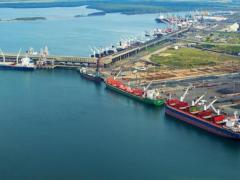
Terminal handles 4465 containers in a day Terry Hutson SOUTH AFRICAN Port Operations has emphatically denied recent reports that it refused to accept export containers at the Durban Container Terminal (DCT). The report was made initially in a letter from the executive officer of the KZN branch of the South African Association of Freight Forwarders (SAAFF), Dave Watts, who advised members that ASABOSA (Association of Ships Agents and Brokers of SA) was reporting delays to vessels on the coast because of a build-up of export containers at DCT. These were seriously affecting port operations, he said. As a result, said Watts, the terminal was temporarily not accepting export containers from last Monday (April 14). Not so, replied new DCT manager Ton Bestenbreur. “Exports were accepted at DCT with effect from 14.00 on the 14th April for stacks that were open.” However, he said that no early arrivals were accepted and stack closing times were adjusted to accommodate the time lost. The sudden increase in the build-up of container ships outside the port of Durban has raised new fears over delays and congestion, which Themba Gwala, general manager for the Port of Durban says is partly due to unusually large shipments on some of the vessels. “In the past week the Durban, Container Terminal has had to handle some shipments that were unusually large in volume terms, and this has contributed to the build up of ships waiting outside the port.” Gwala said that DCT had handled an average of 3149 containers a day, which amounted to 22 401 containers for one week. “At the weekend a new daily container handling record of 4465 was set, breaking the previous record of 4000 containers handled in a day.” He pointed out that this new record was the equivalent of handling 1,6 million containers a year or 2,1 million TEUs a year, which is 50% above the design capacity of the terminal. Management and staff were working hand-in-hand to ease the situation, and the new record was evidence of this, he said. Nevertheless port users are concerned over the slow progress in the ordering of new gantry cranes for the terminal as well as the completion of an order for 60 new straddle carriers. They remain convinced that ship handling at the terminal can only become efficient once the port has sufficient gantry cranes to place three or even four to a vessel where applicable.
DCT breaks records to cope with deluge
Comments | 0
© Now Media. This content is protected by copyright and may not be adapted or republished. If you would like to discuss cooperation opportunities, please contact: editor@freightnews.co.za.