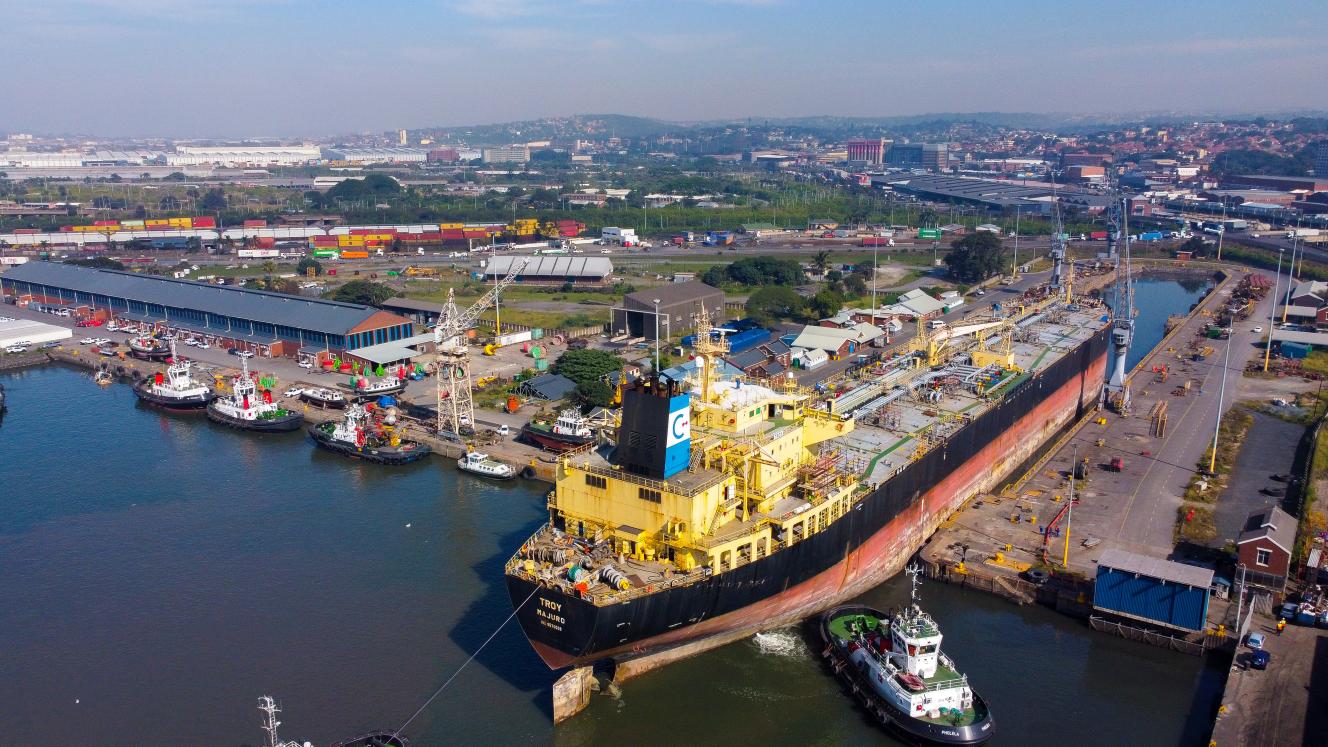
The sudden appearance, in some instances re-appearance, of dredgers in the ports of Cape Town, Durban and Richards Bay would seem to point to Transnet’s initial under-estimation of the need for deeper ports to allow for the changing face of shipping. This became apparent in conversation with Sanjay Govan, the NPA’s port manager for Cape Town, as the Transnetcontracted, Belgian-operated dredger Palletier was about to start deepening operations in the port of Cape Town. “When the master plans were designed for Cape Town, Durban and Ngqura five or six years ago, the thinking was not focused on huge depths,” says Govan. “We now have to do that rethinking with dredging to start in Durban and Cape Town.” The Cape Town operation, expected to last for up to two months, involves deepening the entire channel to a depth of 15.5 metres. Govan says when a start was made with design of the R5.5 billion Cape Town Container Terminal expansion project, the dredging depth of the basin was set at 15.5m, in line with what the shipping lines wanted. “However, with the type of vessels they are now starting to bring in, ships of over 8 000 TEUs, 15.5m is not deep enough, so given Cape Town is the first and last port of call by the lines, they are obviously having constraints.” These would perhaps entail coming into port only 80% laden in order to make the draught and for the vessel to sail with a large amount of empties. “The slight misunderstanding is that the determination of under keel clearance by shipping line marine specialists was far less than what our harbourmaster and pilots were putting down as a minimum, 1.3m, and the reason we are doing that is wind-related. “Coming into Table Bay, a vessel’s movement is far greater than in other ports so your under keel clearance cannot be less than 1.3m.”
CT rethinks depth requirements
Comments | 0
© Now Media. This content is protected by copyright and may not be adapted or republished. If you would like to discuss cooperation opportunities, please contact: editor@freightnews.co.za.