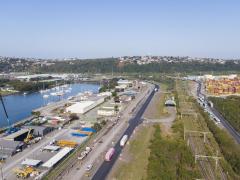
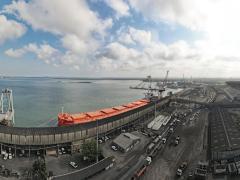
Public Enterprises Minister Malusi Gigaba and Transnet CEO Brian Molefe were in the firing line last week as they celebrated the last stage of Phase 1 in the development of Transnet’s new multi-product pipeline (NMPP) project, and the construction of the coastal terminal, TM1. The two told a media group in Durban that they were there to celebrate the “within budget and “on-schedule” completion of the pipeline. Scheduled for completion in December 2013, TM1 (together with TM2 in Jameson Park, near Heidelberg, Gauteng) will see the pipeline finally able to carry all grades of petrol, diesel and jet fuel, and making it a full multi-product facility. But what they really meant was they were celebrating the completion to a new budget and a new schedule. The progress of the pipeline project has met with considerable complaint as it has been fraught with on-going cost escalations and delays. The original budget for the project leapt up by 146.3% – from R9.5 billion in 2006 to R23.4 billion now. Also, full completion was originally estimated for the first quarter of 2011 but was eventually delayed until December 31, 2013 – although it has partly been operational. Diesel first started to flow through the NMPP from Durban to Heidelberg for the first time on Wednesday, January 11. According to Molefe at the time, the diesel took a week to travel the 555km from the Durban port to the Jameson Park inland terminal in Heidelberg, at a speed of 6kph to 7kph. “We are now able to concurrently run the Durban to Johannesburg pipeline and the NMPP with petroleum products that will see some three million litres per hour…. flowing between Durban and Johannesburg every week,” he told reporters. But it will be another year before the NMPP lives up to its full name of multi-product. The increases have also had an impact on pipeline tariffs as costs for the infrastructure are recouped. In March, the National Energy Regulator (NER) announced a 22% increase in the pipeline tariff, which was expected to cause a 4c per litre hike in the petrol price. But once the whole cost of the NMPP is included in the tariff what will the result be? FTW asked this question of Charl Moller, former head of Transnet Pipelines and now group executive in charge of Transnet Capital Projects. The current transportation factor (of the pipeline) – for which the NER is responsible – is 22 cents per litre, he said. “Obviously, the more throughput that goes through the pipeline, the lower the tariff will be,” Moller added. “Our model shows that it will peak at 34c/l, 12c/l over the current amount. “But, in the long-term – when 3 million litre/hour, or 26 billion l/annum are running – we believe it will stabilise at 25c/l.” The other part of Transnet’s calculations related to the cost of transporting through the pipeline versus the cost of road transport. “To compete,” said Moller, “we’ve got to be 40% cheaper than road transport.” Achieving this, he added, has seen Transnet Pipelines combining with the specialised pipeline unit at Transnet Freight Rail (TFR). “This combination should smooth out the effects of tariff price hikes,” he told FTW. But, Moller stressed, the whole life of the pipeline – 70+ years – has to be taken into account. “To do the real sums, they must be done over this whole lifeline.” Molefe also tried what can only be termed an abstract factor when excusing the fuel price increases effected by the pipeline. You must also take into account the fact that the pipeline is environmentally friendly, he told FTW. The price increase is, therefore, justified by the fact that the pipeline is conserving the environment, and reducing the damage to the ozone layer. When FTW accused him of being “ethereal” in his argument, and pointed out that a transporter who was struggling to survive or a motorist who was faced with ever-increasing costs, was not going to say that he was paying X cents more per litre, but helping Transnet to be green, so it was OK – Molefe still stuck to his guns. But minister Gigaba did admit that he had been seriously disturbed by the rising costs and time delays. This, he told FTW, had prompted the launch of an independent review of the project. This review included three independent reports on the governance, engineering and project management aspects of the pipeline, as well as an independent legal opinion. CAPTION Malusi Gigaba ... celebrating last stage of Phase 1 in the development of Transnet’s new multi-product pipeline.
Costs and delays spoil Transnet’s pipeline party
Comments | 0
© Now Media. This content is protected by copyright and may not be adapted or republished. If you would like to discuss cooperation opportunities, please contact: editor@freightnews.co.za.