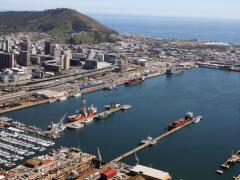
Manganese producers in South Africa cannot grow their export business as long as they have limited rail capacity. “There simply is not enough capacity,” Johan Kriek, CEO of manganese ore producer United Manganese of Kalahari (UMK), told FTW last week. “Mine production is out of our hands as a result. Simply put, we will sell as much as we can get to port. Rail capacity is a huge challenge for us.” The company, which is the fourth-largest manganese producer in the world, is in the final stages of building its manganese mine, which has a design capacity of 2 million tpy. Construction will be completed by December, but already the mine can produce 3.6 million tpy, Kriek said. UMK rails its ore to Port Elizabeth and Durban, and it has a considerable rail allocation from Transnet. Yet the company has to supplement the railing of the ore by trucking, mostly to the Durban port. The company cannot consider growth strategies if it cannot transport the ore to port, Kriek said. “We have to do it via viable channels,” he explained, adding that the rail transport was more economical by a large margin than road transport, which is a major consideration for a manganese ore miner in a market where manganese prices are on a downward spiral. Other miners agreed. An official at a small manganese mine told FTW that because his company shipped relatively small quantities, his rail allocation was a lot smaller than for other companies. “We don’t get much capacity on rail because we are small. So our scope for growth as a business is limited, seeing that our growth is directly linked to how much ore we can move,” an official at the mine said. He said the little allocation his company did get amounted to two carriages, which the company had to load from a shared loading port. “We have two hours to load,” he explained. “You have some delay somewhere which eats into your loading time. When that time is over, it’s done for that specific train.” He said that he had used trucks on occasion, but being a small business with limited scope for growth in the current logistics environment, trucking was only an emergency option. “It is so expensive, and will now become more so with fuel price inflation,” he said. “Trucking our ore is simply not an option. It will kill our business. At least we are shipping from our stockpiles at the moment so we don’t have other mining costs to offset against our income. Can you imagine how much it hurts the guys who are producing from their mines?” Transnet is planning a R300-billion investment in expanding its rail network, which includes building a manganese-dedicated rail line to address the capacity shortage on the network for manganese exporters.
Constrained rail capacity mutes manganese mining growth
Comments | 0
© Now Media. This content is protected by copyright and may not be adapted or republished. If you would like to discuss cooperation opportunities, please contact: editor@freightnews.co.za.