African ports need to address
bottlenecks and improve
service delivery if they are to
compete in the
global shipping
arena.
Governance
and
administration
at various
ports are often
extremely
frustrating
due to the slow
and inefficient
processes followed, while
the lack of necessary
infrastructure further
compounds the issue,
according to industry
commentators.
“The customs procedures to
clear and move cargo through
African ports are long-winded
and so it takes time,” said
Gerald Hagemann, director
of business development at
Meihuizen International.
Clearing at some ports in
Africa can take more than 20
days for a single piece of cargo.
“Port operations in Africa
are often just seen as a
function and not necessarily
as a line of business and part
of a production line,” said
Napo Ramodibedi, CEO
of Mendi
Maritime.
“If one were
to compare
African ports
to those in
Asia, for
example, one
would clearly
see how in
Singapore the
port and its
operations are production
lines. The core focus is on
doing it as well and efficiently
as possible. That is not the
approach in Africa.”
James Lewer, line manager
for Safmarine’s SAFWAF
Service, said procedures for
customs clearing were often
not streamlined and proper
systems were often not in
place.
Pre-clearance is also a
concept that has yet to take
hold in Africa. While the rest
of the world is clearing cargo
long before the vessel has even
arrived, most African ports
refuse to start any clearance
procedures until the vessel
has docked. This alone
can take up to 12 days at
congested ports with berthing
delays.
According to Hagemann,
there has been a major focus
on improving service delivery
in the container sector, but
the breakbulk and project
cargo arena was still not a
major focus for ports in the
region.
Oritsematosan Edodo-
Emore, managing partner at
Edodo, Thorpe and Associates
in Nigeria says all of these
issues are compounded by
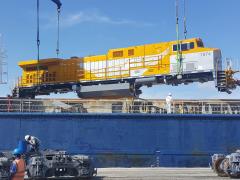
the lack of equipment and
infrastructure.
“Too often there is simply
just insufficient and inadequate
cargo handling equipment.
Ports require particular
equipment for project cargo
lifting and unfortunately at
the ports in West Africa in
particular they don’t always
have the correct handling
equipment – or if they do it is
often not functioning.”
INSERT & CAPTION 1
Pre-clearance is a
concept that has yet
to take hold in Africa.
– James Lewer
INSERT & CAPTION 2
The customs
procedures to clear
and move cargo
through African ports
are long-winded and
so it takes time.
– Gerald Hagemann
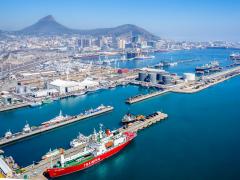
CAPTION
Port of Mombasa... most African ports refuse to start any clearance procedures until the
vessel has docked.
Complex customs procedures constipate ports
Comments | 0
© Now Media. This content is protected by copyright and may not be adapted or republished. If you would like to discuss cooperation opportunities, please contact: editor@freightnews.co.za.