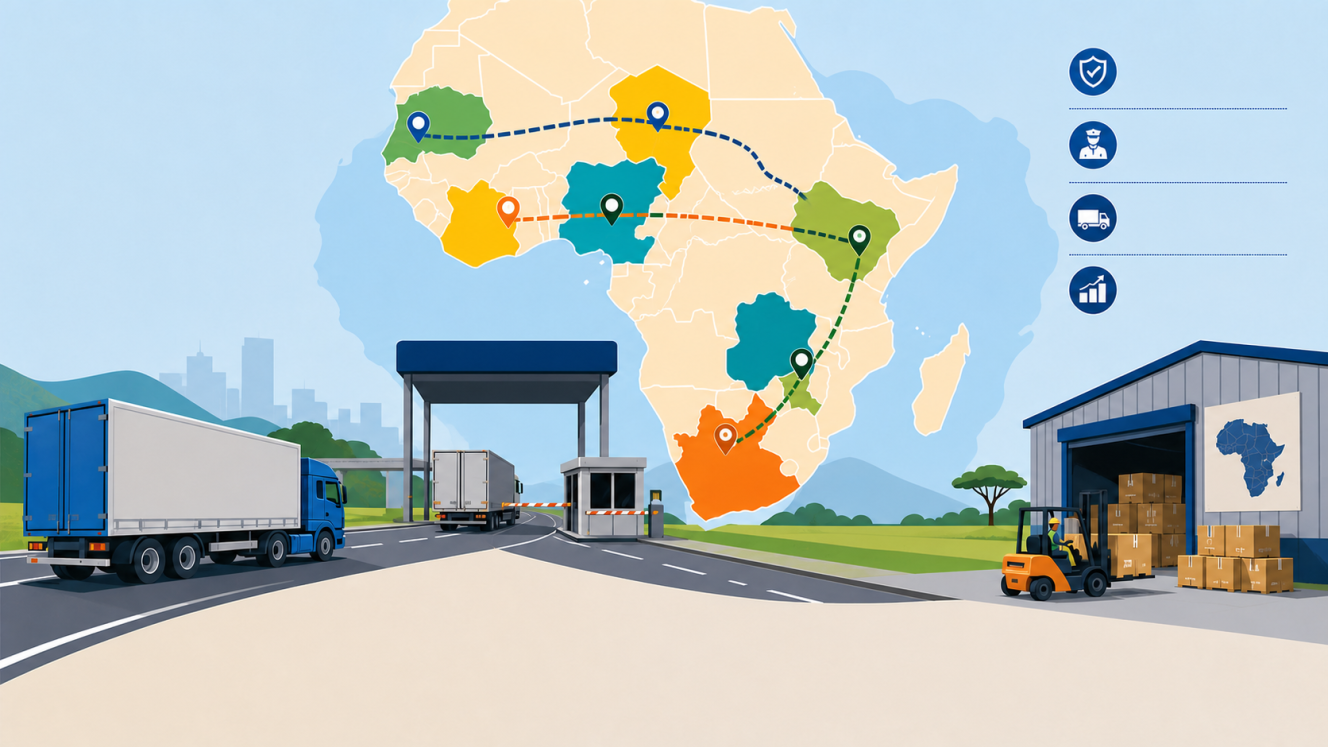
Digital border processes and pre-clearance systems will become increasingly important to the profitability of cross-border road freight operations as intra-African trade and e-commerce expand.
Africa’s cross-border road freight market is forecast to grow from $9.81 billion (about R158bn) in 2025 to more than $12.38bn (about R199bn) by 2031, according to Mordor Intelligence.
Andre Klynsmith, founder of logistics platform Laaimylorrie, believes border administration, rather than road infrastructure, is becoming the principal obstacle to efficient freight movement.
“The corridors are mostly built. The asphalt is no longer the bottleneck – the border post is. For SADC freight operators, the difference between a profitable load and a loss-making one increasingly comes down to whether a truck can be pre-cleared before it ever leaves the yard,” he wrote in a company blog.
“For an operator running the Trans-Kalahari, North-South or Beira corridors, the implication is that competitiveness will increasingly be won in the paperwork, not just the kilometres.”
Transport and warehousing operators will therefore need systems capable of managing customs documentation, shipment data and cross-border payments before trucks reach border posts.
The rapid growth of mobile commerce is adding to the need for digital logistics systems as mobile money, smartphones and online selling reshape African supply chains.
Sub-Saharan Africa is “the epicentre of mobile money”, with more than 1.1bn registered accounts, according to GSMA director-general Vivek Badrinath.
Mobile technologies and services generated $240bn (about R3.87 trillion) in economic value across Africa in 2025, equivalent to 7.8% of regional gross domestic product, according to the GSMA Mobile Economy Africa 2026 report.
The sector supported about 13 million jobs and contributed $45bn (about R725bn) in public revenues, while mobile-money merchant transactions exceeded $155bn (about R2.5trn).
This growth is shifting logistics operations from periodic, store-based replenishment towards continuous, data-driven fulfilment tailored to individual customers.
The change involves more than an increase in parcel volumes, affecting inventory management, transport, payments, warehousing, deliveries and returns.
Mordor Intelligence estimates that wholesale and retail trade accounted for 29.12% of Africa’s cross-border road freight revenue in 2025. The segment is forecast to grow at a compound annual rate of 4.62% until 2031.
Full-truckload freight held a 52.78% market share in 2025, although less-than-truckload services are forecast to record the strongest growth, at 4.05% a year.
Long-haul movements accounted for 62.95% of the market and are expected to grow at an annual rate of 4.31%.
Non-temperature-controlled freight dominated with an 87.12% share, while temperature-controlled services are forecast to record the fastest annual growth, at 4.08%.