As Transnet Freight Rail
(TFR) gets set to pilot its
first bimodal (road on
rail) units before the end
of the year, RailRunner
SA CEO Mike Daniel told
delegates at Gas Africa in
Johannesburg last week
that LNG transport was a
feasible option using the
technology.
The
initiative,
which is
a 50/50
agreement
between
TFR and US
company
RailRunner,
ticks all
the boxes
in terms of
costs and
efficiencies,
in the view
of TFR and its partner.
“When you look at
bimodal, there are a couple
of facets,” said Daniel.
“One is the terminal
– a bimodal terminal
can cost almost as much
as a runway because
infrastructure is immense.
But RailRunner – with the
trailer and the bogie – is
a disruptive technology.
It works at a terminal
anywhere and makes
the terminal easier and
cheaper.
RailRunner intermodal
trains are assembled
directly from the
container-carrying
RailRunner highway
chassis, using compact
specialised rail vehicles
called “bogies.” The
chassis and container are
coupled to the bogie. The
highway wheels are raised
pneumatically, allowing the
highway wheels to clear the
track, thus transforming
the road vehicle to a rail
vehicle in a matter of
minutes.
Train
assembly
requires no
lifting of
the shipping
container,
and is fast,
simple and
cost-efficient,
according to
Daniel.
“Because
of the space
between
vehicles we can add more
containers to a train than
conventional rolling stock
and can provide container
intermodal as well which
is otherwise not possible
in South Africa. Whatever
trailer can go on the road
can go on the bimodal
vehicle. We can put on
anything from tankers and
cement trucks to f latbeds
and containers. The
strength of the unit is not in
the box but in the f loor of
the trailer.”
Daniel is also
convinced that in TFR it
has a world class partner
for the technology.
“We’re often asked
‘How can you work with
Transnet – they’re so
inefficient?’.”
“Our response is simple.
Later this year there’s a
heavy haul conference in
Cape Town and people
from all over the world
are coming to study what
Transnet is doing on the
coal and iron ore line.
“Transnet is world class
at loading from terminal
to terminal – and with
bimodal someone has
to find a load on road,
someone else will bring
the load to a terminal and
someone else will operate
the terminal; someone
will produce a RailRunner
block train and Transnet
will pick up a loaded
train at point A
and drop it off at
point B. Everyone
is playing to their
strengths and not
their weaknesses
and Transnet is no
longer trying
to be all
things to all men but focus
on its core business.”
Daniel said when they
started talking to Transnet
they were told the CT to
Johannesburg leg would
take six days. That’s now
down to three days or
better.
“Their objective is
whatever a truck can do
plus a day. The day is
required to pick up a load,
put it in the terminal, put
it on the train, haul it from
point A to point B and do
the whole system in reverse
again.
“The time has come for
co-operation between rail
and road and between
private entities and stateowned
entities.
“We focus on
efficiencies and do
what we’re good at
to become more
competitive.”
INSERT & CAPTION
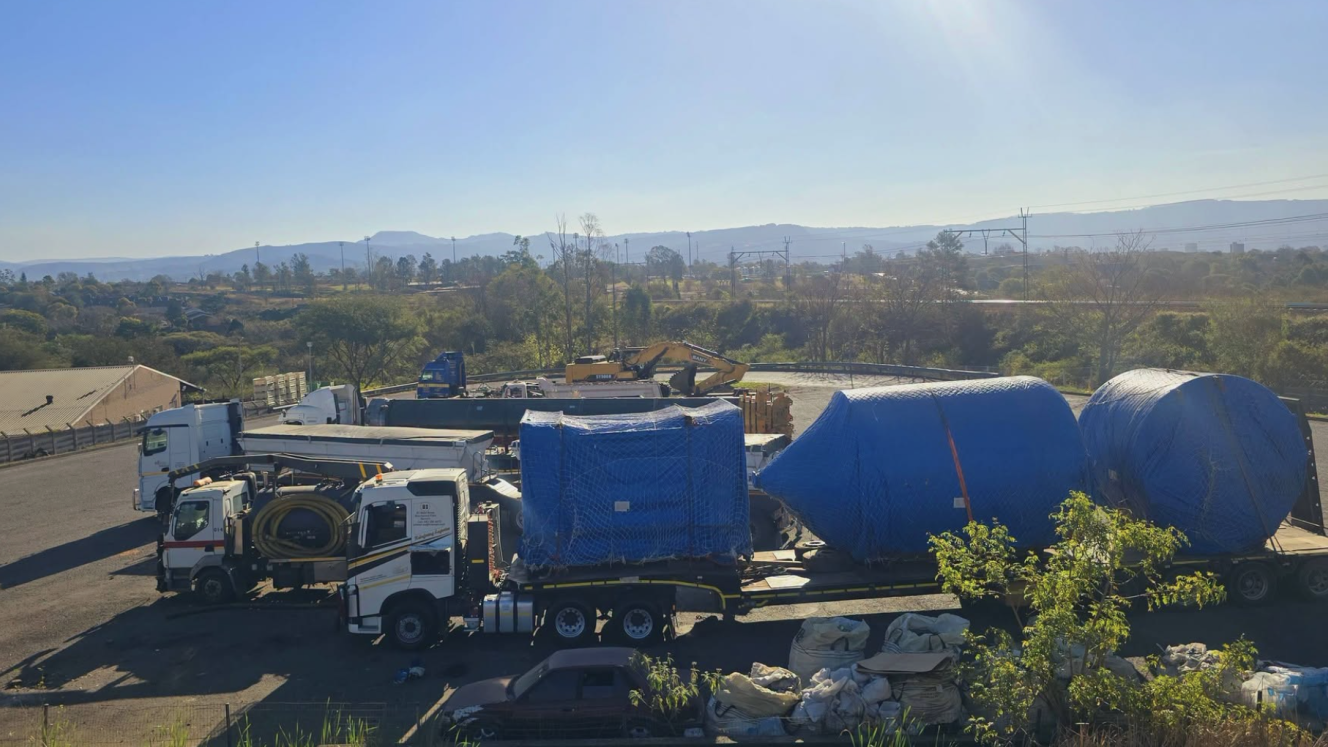
Whatever trailer can
go on the road can
go on the bimodal
vehicle.
– Mike Daniel
Bimodal technology well suited to LNG logistics
Comments | 0
© Now Media. This content is protected by copyright and may not be adapted or republished. If you would like to discuss cooperation opportunities, please contact: editor@freightnews.co.za.