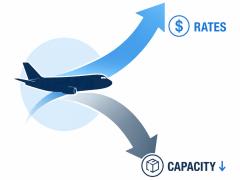
The airline industry is facing an uphill challenge as it readjusts to revised growth forecasts in an increasingly competitive market. And it’s greatest threat comes not from the airline industry itself, but from its seafreight competitors as cost-conscious shippers weigh up the modal benefits. “Growth forecasts for 2009 have been revised from 3.3% at the beginning of the year to 1.9% in October,” Air France KLM vice president Middle East, India, Eastern and Southern Africa, Guy Lenain, told FTW in Johannesburg last week. And for an industry that has geared up its resources to cater for almost double that growth, the impact is concerning. Cargo volumes provide a barometer of the health of the world economy, and International Air Transport Association figures are an accurate reflection, says Lenain. “If you look at Iata figures for October in terms of ton kilometres, they have decreased by 7.9%. By October we were in negative territory with a -0.8% increase. And bearing in mind that companies have based their plans on 5% average growth, the extent of the problem is clearly evident. “Airlines have been ordering new aircraft and these have started to arrive – the result is overcapacity.” In addition, older aircraft that were taken out of service because they were not fuel-efficient are now being reinstated because the oil price is much lower. And while Lenain admits that shipping is a cyclical business, he says fluctuations like those currently being experienced are unprecedented. The volatility of the oil price is a further concern – US$145 in July down to around $50 currently. “No-one knows what the price will be tomorrow. We are entering unknown territory which makes it all the more difficult to strategise for the future.” Survival relies on speedy decision-making, says Lenain, and high priority is cost-control. Air France KLM has put in place a cost-saving programme to address the current scenario. “Our previous plan – Challenge 10 – was devised for the period 2007-2010,” said Lenain. “This has been superseded by Challenge 12 which caters for the more severe economic circumstances and which will save ¤260m more than the previous plan, and in fact just for the year 2008/09.” The first priority, says Lenain, will be to reduce capacity. “Our planned 4% growth has been reduced to 1.7% for the Winter 08 programme and will be further reduced to 1% for Summer 09.” And while the airline has no plans to cut capacity on the SA route, it will continue to monitor load factors and adjust capacity accordingly. Synergies created by the merger are also helping to reduce costs, says Lenain. Chief among these are the economies of scale achieved through joint purchasing as well as staff and office consolidations. He made it clear, however, that there had been no retrenchments as a result of the merger. The airline is also rethinking its fleet renewal programme in light of the revised growth prospects. “The phase-out of the B747 400 ERF from the Air France fleet could be delayed. Originally it was intended to take place from 2009- 2012. Because of the cheaper fuel price, there’s also less urgency to replace the fleet with more fuelefficient alternatives. “We are also carefully considering all other investments like warehouses, offices and the like. The only investment area in which we will not hold back is IT.” In the long-term, Lenain believes that environmental factors will take centre stage, and it’s an area in which Air France KLM has already invested significantly – ¤14 bn to renew the fleet not only because it is more fuelefficient but because it cuts down on CO2 emissions. AF-KL Cargo will be the launch company for the B777F – which will reduce C02 emissions by 18%. Clearly the airline industry has a difficult few years ahead and Lenain is convinced that mergers will continue to be the order of the day.
Airlines face negative growth as bigger planes start arriving
Comments | 0
© Now Media. This content is protected by copyright and may not be adapted or republished. If you would like to discuss cooperation opportunities, please contact: editor@freightnews.co.za.