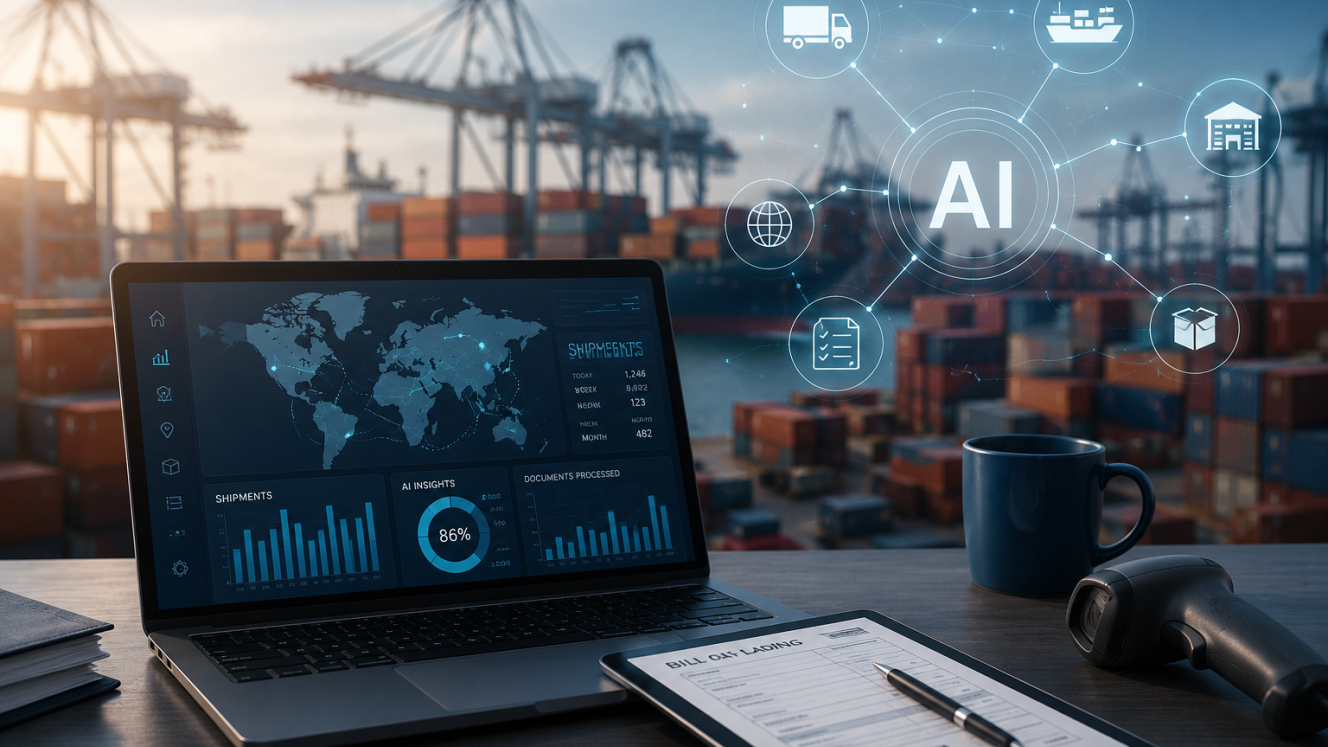
Supply chain companies are experimenting with artificial intelligence, but fewer than a quarter have deployed the technology at scale as skills shortages, change-management challenges and fragmented technology systems hamper adoption.
Only 22.2% of respondents to a global supply chain survey said AI had been deployed across multiple teams or was core to their operations and decision-making.
A further 34.6% had AI in production on a limited scale, while 30.8% remained in the early experimentation stage and 12.4% had not yet started adopting the technology.
The findings are contained in The State of AI in Supply Chain report, based on an independent survey by The Loadstar of more than 200 supply chain executives and practitioners worldwide. The report was supported by AI technology company Raft.
Freight forwarders and third-party logistics providers accounted for nearly half of respondents, while the remainder included shippers, carriers, customs brokers, port operators, consultants and technology providers. More than half of respondents were at vice-president level or above.
Skills shortages hamper adoption
A lack of in-house AI expertise and change-management capability was the most frequently cited barrier to scaling AI, identified by 53.8% of respondents.
Integration with existing technology systems followed closely at 48.7%, while budget constraints and unclear returns on investment were each cited by 32.1%.
Integration problems were also the leading reason companies had either not adopted AI or abandoned initial efforts, cited by 29.9% of respondents, followed by data quality challenges at 27.8%.
The report found that 65.8% of respondents believed data quality and integration would be the biggest factor separating AI leaders from laggards over the next two to three years.
Despite the challenges, companies that had implemented AI reported tangible operational benefits.
Document extraction and processing emerged as the leading area of measurable impact, cited by 79.7% of respondents who reported operational benefits from AI.
Among organisations reporting tangible AI impact, 89.5% cited improvements in speed and productivity, while 47.4% reported improved accuracy and 34.6% identified cost reductions.
However, measuring the financial return from AI remained a significant challenge.
Almost two-thirds of respondents (62.8%) said they had either not measured the return on their AI investments or were unsure how to do so. Only 23.9% said their AI initiatives had met or exceeded expectations.
The report suggested that AI benefits were often reflected in increased operational throughput, such as processing more shipments, documents or exceptions with the same workforce, rather than significant reductions in employee working time.
More than half of organisations reporting tangible AI benefits said the technology had reduced desk time by less than 15% or not at all.
Trust and security concerns remain
Human oversight remains central to the use of AI in supply chain operations, with 67.9% of respondents saying AI-generated insights were reviewed before being implemented.
Only 4.3% reported high trust in AI outputs, while 39.3% of organisations were actively addressing AI-related security risks.
The report concluded that companies were unlikely to gain a competitive advantage simply by gaining access to AI technology. Instead, their ability to integrate data, measure returns, secure employee support and embed AI into everyday operations would determine whether experimental projects could be scaled successfully.