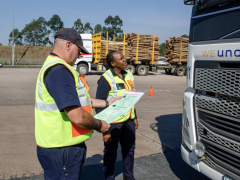
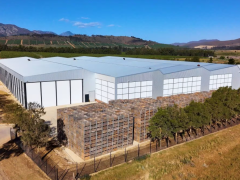
The Walvis Bay Corridors are seen as a model for successful and sustainable economic corridor development across Africa’s internal borders. Most corridor initiatives, which either predate the formation of the Walvis Bay Corridor Group (WBCG) in 2000 – following the official opening of the Trans- Kalahari Corridor in 1998 and the Trans-Caprivi Highway in 1999 – are still little more than good ideas on paper. Corridors do not just happen – they need a well-resourced and funded secretariat backed by political will and the support of the private sector. Their success, which has been followed closely by FTW, is based on a public-private partnership in which government, the port authorities and the private sector have been close partners. The corridors have been driven by a common vision reinforced by ongoing investment by the parastatal port, road and rail authorities. Marking the formation of the WBCG was the completion of the deepening of Walvis Bay to 12.8 metres and the introduction of direct calls at Walvis Bay by Maritime Carrier Shipping (MACS) and Maersk to and from Europe. This eliminated the need and cost of transhipping through Cape Town. Having the direct calls put the Namibian logistics sector into overdrive. Walvis Bay became the preferred port for freight into southern Angola, making the Trans Cunene corridor the early success story. The Trans-Caprivi Highway became viable in 2004 when a bridge over the Zambezi River at Katima Mulilo (Namibia) and Sesheke (Zambia) was completed. Since then the WBCG has worked with the governments of Namibia, Zambia and the Democratic Republic of Congo (DRC) to eliminate bottlenecks in order to reduce costs by minimising border delays. The United Nations Conference on Trade and Development’s (Unctad) capacity-building programme, which was set up in 2005, identified the Trans- Caprivi Corridor as a model corridor in Africa, and supported the development of the Corridor’s cluster committee. The committee is made up of public and private transport representatives who meet twice a year to address corridor issues. Now, 15 years later, the government and WBCG are working at transforming the transport corridors into full logistics corridors. Again the infrastructure is being created to sustain the development – new container berths are being added to the port of Walvis Bay and work is due to start on a second “SADC port” in the bay. “Namibia has a clear vision to become a regional leader in logistics and distribution in southern Africa. Our current National Development Plan Four (NDP4) has identified logistics as one of the economic priorities, an area in which Namibia has a clear comparative advantage. Against this background, Namibia has embarked on a transformation process to establish itself as the ‘Logistics Hub for Southern Africa,’” says the WBCG on its website. This may seem ambitious given the dominance of the South African port network in the region. But, as Gadzeni Mulenga pointed out in a 2013 brief for the African Development Bank, “Transport corridors can accomplish much more than linking point A to point B. With the economic corridor concept, Africa’s transport corridors can not only facilitate regional integration and trade but can also reduce poverty, particularly in catchment regions. “Planners can achieve this by carefully coordinating the social, economic and physical development of the corridors and their surroundings.” And that is what makes the Walvis Bay Corridors and Namibia set the benchmark for transborder corridor development in Africa. The initiative has the full support of government and its parastatals which are ensuring that the infrastructure and enabling environment are in place. Business is adding its weight by investing heavily in the region, as is evident by the large number of new warehouses going up in Walvis Bay and Windhoek, and the entry of new freight, logistics and clearing companies into the country. Established Namibian companies are also ensuring that they remain competitive by ongoing investment in people, facilities and equipment – a true partnership between the private and public sectors. Like all partnerships it has its challenges, but there is a reservoir of goodwill and the structures are in place to find common ground in order to reduce the costs of doing business across borders for Zambia, Zimbabwe, Botswana, the DRC – and Gauteng. CAPTION The corridors have been driven by a common vision reinforced by ongoing investment by the parastatal, road and rail authorities – and of course the Port of Walvis Bay.
WBCG a model for facilitation cross-border trade
Comments | 0
© Now Media. This content is protected by copyright and may not be adapted or republished. If you would like to discuss cooperation opportunities, please contact: editor@freightnews.co.za.