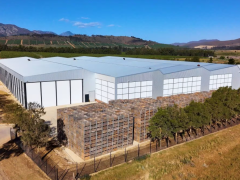
Warehousing operations are being transformed from “cost centres to growth centres” through the use of information technology. The trend was identified in 2013 by Motorola in its widely referenced white paper on expected warehousing trends up to 2018. South African companies and operators have identified the need and opportunity. In the 2014 supply chain foresight survey by Barloworld Logistics, 55% of respondents ranked “using supply chain as more of a competitive advantage” as one of their top three strategic business objectives. Motorola based its predictions on a survey of people working in the manufacturing, retail, wholesale and third party logistics sectors. “Survey responses reveal a forward-looking new way of viewing the warehouse: no longer as a pure cost centre in which operational focus is placed almost exclusively on wringing out inefficiencies and inaccuracies in order picking, but increasingly as a powerful asset that can drive profitable growth for the business with a heightened focus on improving inbound storage and outbound material handling,” says the report. Developments in the warehousing sector in the 22 or so months since the report was published in April 2013 have confirmed the trends it identified. One of the trends is the move to “mega” warehouses and distribution centres – one which has its roots in the pre-recession years. The second-largest building in the world is reported to be the 185 800- sqm Target Import Warehouse in Lacey, Washington. Opened in 2003, it has a volume of 7.43 million cubic metres and distributes imported products to the retailer’s warehouses across the States. In South Africa, Toyota opened a 39 000-sqm site in October 2012. It will be one of the biggest warehouses on the African continent when a second phase of 38 000 sqm comes on stream. At the opening it was said that the warehouse carried 2.2 million parts pieces of 110 000 different parts and components, valued at more than R350 million. In order to transform increasingly complex operations such as these from cost to growth centres warehouses should not be treated as “separate islands of information,” says the Motorola report. “The vision for the future is the linkage, integration and consolidation of the Warehouse Management System (WMS) with Enterprise Resource Planning (ERP), the Yard Management System (YMS) and Transportation Management System (TMS). “These linkages help remove inefficient information silos, promoting collaboration and increasing the recognition that changes in one process can and will affect others downstream and upstream. “For example, changes in packing and staging can affect load plans, trailer drops, route selection, rates and more. “Anticipation of – and response to – these effects is crucial to not only improve warehouse efficiency and productivity, but also to create a more synchronised and agile supply chain,” says the report. It seems that South Africa is not keeping up with the trend. In the World Bank Logistics Performance Index (LPI), South Africa has decreased to 34th out of 160 countries from 23rd out of 155 countries in 2012. “Of the six factors considered in determining the LPI, customs (ranked 42nd compared to 26th in 2012) and tracking and tracing (ranked 41st compared to 16th in 2012) are the worst for South Africa, strengthening the point around service delivery,” said the 10th State of Logistics Survey published by the CSIR in 2014. INSERT Warehouses are no longer regarded as pure cost centres but increasingly as powerful assets that can drive profitable growth for the business. CAPTION Toyota’s warehouse in Ekurhuleni will be one of the biggest on the African continent when a second phase of 38 000 sqm comes on stream.
Warehouses move from cost centres to growth centres
Comments | 0
© Now Media. This content is protected by copyright and may not be adapted or republished. If you would like to discuss cooperation opportunities, please contact: editor@freightnews.co.za.