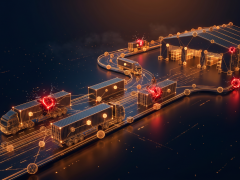
Cutting-edge technology enabling real-time data feeds from railway rolling stock is currently being tested by Transnet on the north-south corridor (NSC) linking the ports of Durban and Richards Bay with lines in Botswana and Zimbabwe going up to the copper belt area of Zambia and the Democratic Republic of the Congo (DRC). Ravi Thaver, senior manager at Transnet International Holdings, said the technology, which is currently in “a proof of concept (PoC) phase, will allow the organisation to access liveposition information about wagons, their cargo and related conditions of freight travelling on the corridor. Following an extensive period during which information about the technology was requested from various potential suppliers, Thaver and his team proceeded to test devices from at least 17 contenders for the final contract. “We allowed each of the PoC participants to give us 20 units to test, and each wagon on the NSC is currently fitted with at least one of the units from four different suppliers.” Given the spread of different devices from a multitude of possible partners, Transnet is currently gaining a thorough understanding of how the tracking tech could help the corridor improve its efficiency which is said to be running below par. Thaver, who also chairs the Maputo corridor from Mozambique’s primary port into South Africa and eSwatini, said Transnet was running nine million tonnes on that corridor at the moment, an annual bulk freight figure that could be expanded to 14 million tonnes. However, on the northsouth corridor, despite its potential for servicing several SADC countries that have economies configured around exporting vast quantities of raw minerals, the NSC’s annual yield is vastly different from that of the Maputo corridor. “We’re moving 750 000 tonnes a year on the NSC and hopes are to increase that to one million. Moving two million tonnes on this line every year would be ideal but current inefficiencies on the NSC do not bode well for realising project volumes.” All of that though seems set to change by the time the tracking devices finally come on line. Before that can happen though, Transnet will whittle down the PoC contenders to about four after which an intensified customisation period is expected to help the parastatal finally pick a technology partner capable of providing tracking devices suitable for African conditions. Says Thaver: “Some of these devices come from places like America but in SADC we are going into rugged regions and we want the technical requirements of these units to be of a particular standard. That’s why it’s very important during the PoC phase to see how these units will perform given the specific challenges that we face.” Keeping the units powered on long distances between key points as the line wends its way into the interior is just one of the important check-list certainties Transnet is grappling with during the testing phase. “We cannot afford to go ahead with final roll-out of the technology if it’s going to run out of battery power or not withstand other challenges on the corridor,” Thaver said. He explained that Transnet's current system of reporting on the NSC, Sprint, was mainly manually based and depended on trains arriving at various points on the corridor. It’s also the reason why Thaver has offices in places like Beitbridge, Livingstone and even Mahalapye in Botswana to ensure effective management of Transnet’s interests on the NSC. However, it means that reporting can’t be done unless a train arrives somewhere, hence clients can often not be kept informed of their cargo. “We are looking at mitigating all these challenges and through the use of liveposition devices should be able to remove doubt and delay of reporting, ultimately being able to know what’s happening throughout the entire corridor whereas previously no one knew anything.” Kudzanayi Bangure, a project manager at the Nepad Business Foundation which assists with consultative management of the NSC, told FTW that the new wagon tech heralded a game-changing development for the corridor. “It’s going to help us with up-to-date data related to the real-time progress of freight along the corridor.”
It’s going to help us with up-to-date data related to the real-time progress of freight. – Kudzanayi Bangure