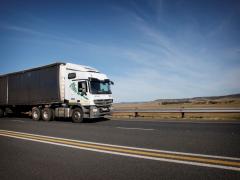
The tragic accident on Fields Hill on September 5 which killed 22 people has led to a frantic search for solutions. As a result, the Kwa Zulu Natal transport MEC, Thembinkosi Willies Mchunu, has been meeting with various transport bodies in the province to try to find answers to the problem. And the Durban Harbour Carriers' Association (DHCA) has presented the MEC with their recommendations to promote road safety, and to avoid another Fields Hill type of accident. A primary finding in this study is that a “prudent professional transporter” would always minimise risk and elect to travel the safer route on the toll road section of the N3 highway – avoiding the dangers of the steep and winding gradient on Fields Hill. It is the other “nonprofessional” transporters that cause the problems, according to the DHCA, and the use of Fields Hill is more often than not an attempt by equally unprofessional drivers to avoid the toll, and pocket the bucks. This alternative route – no shorter and considerably more dangerous than the N3 – also bears its own share of the blame. Heavy commercial vehicles (HCVs) travelling up Fields Hill do not pose a danger to the community, according to the association. But HCVs travelling down the hill are at high risk. The reason, according to the truckers’ body, is “the fact that the road is only two lane, very steep and has no space to place an arrester bed in the event of brake failure or another such emergency. “We believe that all heavy vehicles of over 16 000 kilogrames gross vehicle mass (GVM) should be banned from travelling down Fields Hill.” Looking at general road safety, the DHCA recommends that the state could assist in the matter by insisting that a legal requirement is in place in three, key foundation areas (See “Truckers call for stricter entry levels”, FTW October 18). These are: Entry levels to own and operate a heavy vehicle; driver training on a continuous basis; and holding the owner of the goods being transported responsible for the transporter he appoints. A glaring fault about driver training, according to the association, is that, once a driver of a code 14 has passed his test, there is no legal obligation for any further training throughout his working life. The answer to that, they suggested to the MEC, is that a requirement for regular “Advance Training” and “Defensive Training” for professional drivers – more intensive in his earlier years then more spaced in later years – should be mandatory. Also, a national register for all professional drivers – giving their complete driver history (accidents, fines, etc) – that is open to all prospective employers, should be mandatory. – Alan Peat • This article has been shortened due to space constraints. For the full version go to www.ftwonline. co.za and click on the ‘FTW continued’ menu item. INSERT 1 We believe that all heavy vehicles of over 16 000 kilograms gross vehicle mass (GVM) should be banned from travelling down Fields Hill. – DHCA INSERT 2 A national register for all professional drivers – giving their complete driver history (accidents, fines, etc) – open to all prospective employers, should be mandatory.
The way forward for safe trucking
Comments | 0
© Now Media. This content is protected by copyright and may not be adapted or republished. If you would like to discuss cooperation opportunities, please contact: editor@freightnews.co.za.