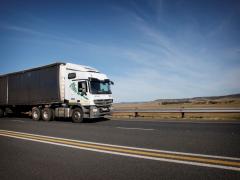
There has been a monumental change in the relative fortunes of road and rail transport in SA in the past 20 years, according to Lawrie Bateman, MD of MSC Logistics. “Some two decades ago,” he told FTW, “the rail monopoly was protected by law inasmuch as you had to apply for a permit to transport goods by road.” And also in those days there were some pretty ingenious interpretations of the categories of goods which would be guaranteed a permit to go by road. “For example,” said Bateman, “under the category heading of ‘tools-of-trade’, an inventive product manufacturer listed washing powder as a ‘housewives’ toolsof- trade’ – and was granted its permit.” But when the permit era was ended there was a dramatic switch from rail to road – including the formerly railexclusive bulk products – which nobody foresaw in its entirety. And one of the triggers for this switch, according to Bateman, was that SA has one of the world’s highest permissible payload limits for road vehicles. “But this has resulted in serious damage to SA’s road network, pollution and road safety issues that need to be addressed,” Bateman said. And Transnet, faced with increasing dissatisfaction, has had to come up with its own counter-measures to recover lost freight volumes. One of these, according to Bateman, was the R80-billion investment, planned to be used to replace ageing locomotives with “good-as-new” rebuilds, and refurbishment of the fleet of rail wagons. “Inevitably that botched tender procedure for 212 locos threw a spanner in the development works,” he said. “And, although it has since been replaced with a tender for 100 locos, this will take time.” In the meantime, Transnet Freight Rail (TFR) has been busy stepping up its communication levels, including a series of meetings with its major clients. “It has also been forming a ‘corridor strategy’ in alliance with the ports management,” said Bateman. “That is taking place under individual general managers for each specific corridor, to ensure a growth profile in terms of their rail efforts.”
TFR ‘stepping up’ communication with major clients
Comments | 0
© Now Media. This content is protected by copyright and may not be adapted or republished. If you would like to discuss cooperation opportunities, please contact: editor@freightnews.co.za.