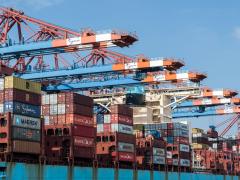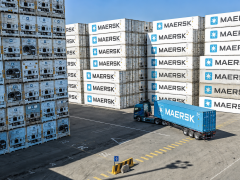
South African container terminals recorded a sharp improvement in throughput last week, with average daily volumes rising 46%, although border delays continue to add significant cost to regional cargo movement.
The latest SAAFF/BUSA Cargo Movement Update, dated May 24, describes port operations as generally positive with most container terminals reporting higher waterside volumes despite weather-related disruptions and ongoing landside logistics challenges.
Total container volumes rose week on week to 61 829 TEUs, according to the report. Average daily throughput was 8 833 TEUs, with the report projecting a lower average of 7 807 TEUs a day for the following week.
The improvement was broad-based, led by strong gains at Ngqura Container Terminal, Cape Town Container Terminal, Port Elizabeth Container Terminal and Durban Pier 1.
Ngqura handled an average of 2 780 TEUs a day, up 70% week on week, while Cape Town Container Terminal handled 2 146 TEUs a day, up 39%. Port Elizabeth Container Terminal handled 1 075 TEUs a day, up 58%, while Durban Pier 1 handled 2 143 TEUs a day, up 15%.
Durban Gateway Terminal maintained strong berth occupancy and steady landside operations, but estimated waterside throughput declined by about 18% to around 23 000 containers or 3 286 containers a day. The report notes that this figure is in containers, not TEUs.
Durban’s landside operations remained under pressure during the week as Bayhead Road experienced significant congestion, particularly during peak hours, the report notes.
Pier 1 recorded a slight increase in waterside volumes, supported by stable stack occupancy and steady truck turnaround times, although truck turnaround times were somewhat higher than the previous week.
Rail cargo on the ConCor line out of Durban rose 25% week on week to 2 955 containers, although the report notes that data coverage for the period was incomplete.
Border delays costly
Cross-border queue and transit delays still carried a material cost for transporters, despite an improvement in average queue and transit times. “The total indirect cost for the week amounts to an estimated $29.9 million (R489 million), down by 13% from about R559 million in the previous report,” the report says.
Border performance was mixed. South African-controlled borders worsened, with median crossing times rising to about 10.4 hours for the week.
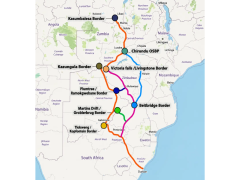
The broader SADC region, improved to about 5.9 hours, with the exception of Kasumbalesa and Chirundu OSBP, where crossing times exceeded a day.
Kasumbalesa was the most affected, with the report noting that it took around two and a half days to cross from the Zambian side. “Kasumbalesa delays intensified this week, largely linked to scanning at Kanyaka in the DRC, with the northbound queue reaching 40km by Thursday,” the report says.
Regional road freight was also affected by several operational issues, including worsening congestion at Kazungula, uncleared vehicles, bond-capacity constraints, delayed T1 acquittals and a BURS CMS tolling system outage.
On the Maputo Corridor, Lebombo showed improvement. Truck volumes through the border post increased 5% week on week to 1 542 heavy-goods vehicles a day. Queue times declined 10% to an average of about 3.7 hours, while average processing times decreased 17% to about 3.4 hours per crossing.
Air cargo a mixed bag
International air cargo softened overall, with total volumes down 6% month on month, reflecting weaker flows at Johannesburg and Cape Town. Johannesburg declined by 5% from March and Cape Town by 15%, while Durban nearly doubled month on month, rising 96%.
On an annual basis, international cargo was still up 6%, driven by Johannesburg’s 10% year-on-year increase. Cape Town and Durban remained below April 2025 levels, declining by 4% and 39% respectively.
Domestic air cargo performed better, with total monthly volumes increasing by 5% month on month and 24% year on year across the three main terminals.
Strait of Hormuz risk shifts
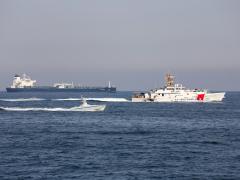
The report also flagged ongoing disruption in the Strait of Hormuz, where the risk had shifted from outright closure to delay, detention, rerouting and commercial uncertainty.
IMF Port Watch data cited in the update showed the seven-day moving average of vessels had fallen to 6.3, compared with 109.9 a year earlier, a decline of about 94%.
The report said passage volumes had “almost collapsed” and that predictability had deteriorated, with delays, risk premia and downstream uncertainty carrying the main operational cost.