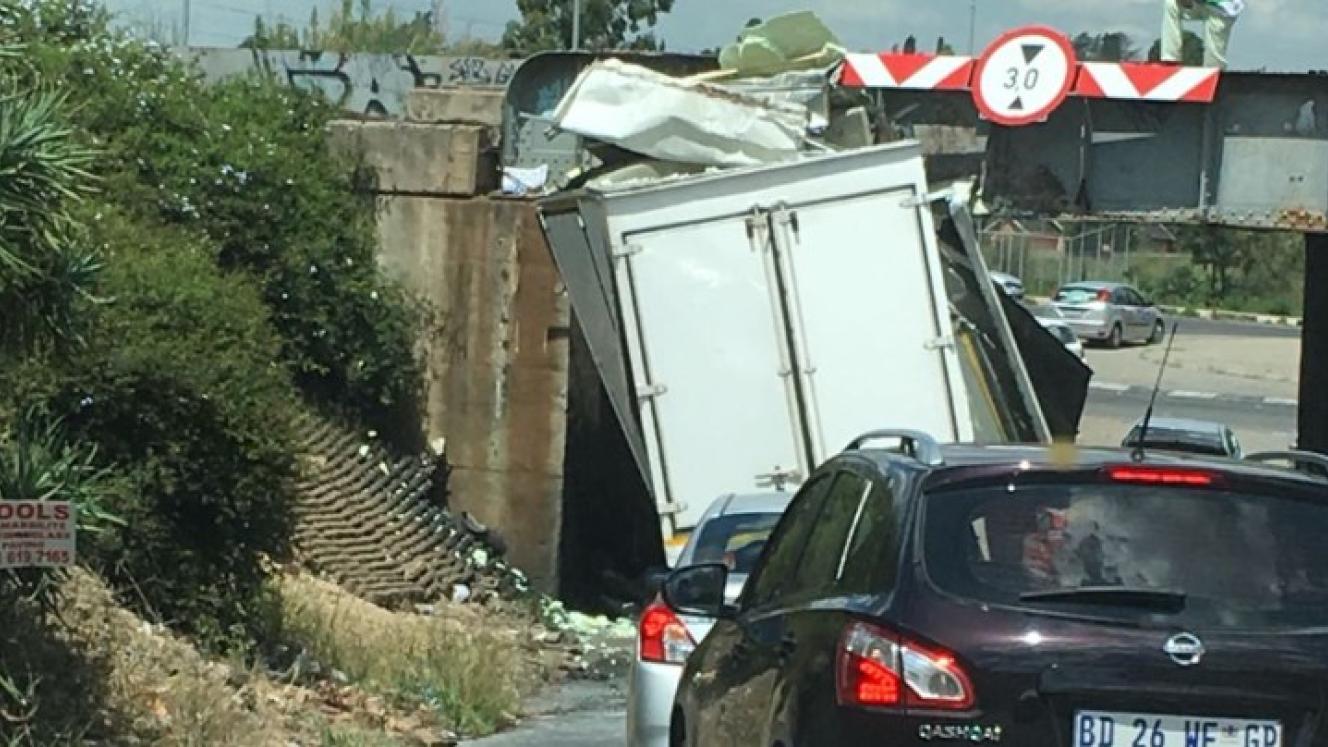
Road signage well ahead of a train bridge in Kempton Park under which trucks regularly become stuck could go some way towards warning transport drivers about the three-metre restriction, says Gavin Kelly, chief executive of the Road Freight Association (RFA).
Responding to an article in Freight News on January 26, ‘Transporters taken to task over bridge issue’, Kelly highlighted industry issues pertaining to route and load intricacies but added that the RFA was perfectly willing to use its resources to assist in the matter.
Unfortunately, the Ekurhuleni City Council has yet to respond to questions about accusations that it’s not using budget allocations to address a logistical problem that has been ongoing for several years.
Last week a local councillor for the Freedom Front Plus, Jéan Kriek, said as many as 50 trucks a year got stuck at the bridge where the M89 (Elgin Road) meets the M57 (Pretoria Road).
On January 26, Chief Specialist for Media Relations at the Office of the City Manager for Ekurhuleni, Zweli Dlamini, said: “The matter is being processed by the Roads Department and a response will be forwarded to you.”
Subsequent follow-ups via email and WhatsApp, enquiring about the undertaking to send a response, have been unsuccessful.
In the absence of official information from either the Ekurhuleni City Council and a pharmaceutical retailer whose road freight service providers have been identified for regularly transgressing the Elgin bridge height restriction, Kelly mentioned a couple of dynamics that should be kept in mind.
He said drivers often miscalculated such restrictions and that proper signposting, flagged as lacking by the likes of Kriek, could help alleviate the problem.
Ideally, warning signs should be positioned well away to help drivers take a different route, Kelly said.
However, route planning prior to trips involving notorious issues should start with the truck driver’s employer, he said. With access to sufficient information, a transporter worth his salt would have done a proper route check.
Route planning was particularly important, said Kelly, considering the December 24 explosion in 2022 when an LPG tanker got stuck under a railway bridge on Hospital Road in Boksburg, killing 41 people and causing destruction across a blast zone of almost two kilometres in circumference.
Kriek has said that the proximity of that incident to the Elgin bridge and its inherent risk, should elicit urgency among the powers that be to avoid a similar calamity.
Last December, almost three years to the day of the Boksburg blast, caused by a driver who deviated off his route to find something to eat, a gas tanker was approaching the traffic circle on Pretoria Road and was about to head to the bridge when the driver stopped.
Such precautionary training wasn’t always present in truck drivers, said Kelly, and deserved to be looked into, including deeper understanding of area awareness and how this could potentially be impacted by the use of sub-contractors, for example.
A service provider “subbing” work to a secondary transporter to meet sudden demand by retailers, could be using drivers that weren’t necessarily familiar with area specifics, Kelly said.
As for how satellite technology could be used to provide drivers with in-cabin warning support, which Kriek examined through Google Maps South Africa supplier, AfriGIS, Kelly said it could be an effective means to avoid low bridges.
“But it comes down to cost; whether transporters actually want to put those sort of systems in place,” he said.