Ten global food companies
have teamed up with IBM to
use blockchain technology in
order to reduce losses and to
improve food safety.
One in 10 people around
the world suffer from food
poisoning every year – and
420 000 of them die,
according to the World
Health Organisation.
The UN Food and
Agriculture Organisation
(FAO) estimates that up
to one third of all food (or
1.3 billion tons) is spoiled
or squandered before it is
consumed by people.
Put in monetary terms,
food losses and waste
amount to roughly US$680
billion in industrialised
countries and US$310
billion in developing
countries.
The companies that are
collaborating in developing a
blockchain logistics network
are
Dole, Driscoll’s, Golden
State Foods, Kroger,
McCormick and Company,
McLane Company, Nestlé,
Tyson Foods, Unilever and
Walmart.
Walmart has been
trialling the use of
blockchain to monitor pork
from China and mangoes
from the United States since
the beginning of the year.
“Blockchain provides
a permanent record of
transactions which are then
grouped in blocks that cannot
be altered,” says Shanker
Ramamurthy, general
manager of strategy and
market development at IBM
Global Business Services.
“When applied to the
food supply chain, digital
product information
such as farm origination
details, batch numbers,
factory and processing data,
expiration dates, storage
temperatures and shipping
detail are digitally connected
to food items and the
information is entered into
the blockchain along every
step of the process.
“The information captured
in each transaction is agreed
upon by all members of the
business network. Once there
is a consensus, it becomes a
permanent record that can’t
be altered.
“Each piece of information
provides critical data that
could potentially reveal
food safety issues with the
product.
“The record created by
the blockchain can also help
retailers better manage
the shelf-life of products in
individual stores, and further
strengthen safeguards
related to food authenticity,”
he says.
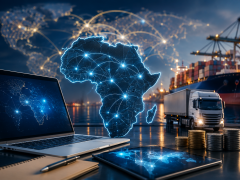
Blockchain technology
may also help identify
logistics bottlenecks in
developing regions such as
Africa.
According to
the FAO, 40% of losses
in developing countries
occur at post-harvest and
processing stages, while
in industrialised countries
more than 40% of losses
occur at the retail and
consumer levels.
A recent IBM Institute
for Business Value (IBV)
study on blockchain in the
supply chain found that
the digital tracking of the
provenance and movement
of food throughout the
entire supply chain helped
improve quality and safety
levels.
Ready-to-eat foods
pose some of the biggest
challenges from a logistics
perspective.
Once processed
there may be a
number of transporters
and warehouses involved
before the product is
placed on the shelf of a
supermarket.
“That’s not only
expensive, but maintaining
the quality standards
set by regulators to keep
perishable products
safe is also a challenge,
particularly when the
product contains frozen
meat, vegetables or milk
products,” says Bridget van
Kralingen, IBM senior vice
president, global industry
platforms and blockchain.
Putting food logistics chains on the block
Comments | 0
© Now Media. This content is protected by copyright and may not be adapted or republished. If you would like to discuss cooperation opportunities, please contact: editor@freightnews.co.za.