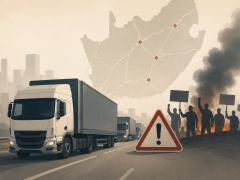
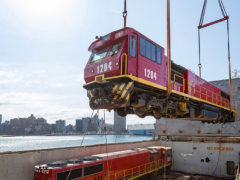
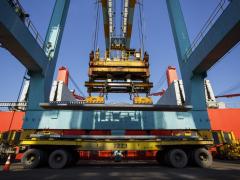
The continuing problem is a shortage of container handling equipment, but Rennie hopes to see this start to improve over the next few months, as the Pier 1 development begins. The initial boost to the terminal's productivity, Rennie suggested, will come as Portnet increases its current fleet of 55 operational straddle carriers to an expected 99. "The indications are that these will start to come in during the first quarter of next year although Portnet is pushing to bring this forward," he told FTW. This, and the proposed increase in gantry crane numbers from 13 to about 20, and the increase in the stacking area, can only improve the current productivity rate, he added. "It has all been given the go-ahead, and has been granted the funds, but it will take two to three years to finalise," Rennie said. "But, as soon as the new equipment starts to arrive, Portnet's productivity will begin to improve, and their ability to overcome unexpected short-term problems - like the strike - will be enhanced." The strike, however, threw a spanner in the already weak works at the docks, he added, and all the lines experienced serious delays following what was literally a 24-hour shut down of the container terminal. In the days immediately following the strike, the Portnet records revealed that the average delay for the eight vessels waiting outside the port had gone out to 69 hours - with the worst two delayed for 87 hrs and 88 hrs. For the three ships inside, waiting to get to the container berths, the average was over 61 hrs - with the worst of the three having a 92-hr wait. On a national basis, according to Rennie, the bulk and breakbulk terminals at Durban and Richards Bay were not affected by the strike. Casual labour was found and the terminals kept running. This was confirmed by Nolene Lossau, executive director of the SA Shippers Council, who reported to FTW that none of the members - many of whom are bulk shippers - had complained of delays. But the container delays, she added at the beginning of September, had probably still to be felt. And it's on the container side that the real problem lay, according to Rennie. "The DCT and Port Elizabeth harbour was where the strike really impacted," he said, "with Cape Town also having problems. But they were also hit by bad weather, so wouldn't have been able to work anyway." And the strike couldn't have come at a worse time, Rennie added. "Here we are," he said, "into the peak season, the volumes high but delays still plaguing us. "It's going to hurt all the lines."
Operators Forum.
Comments | 0
© Now Media. This content is protected by copyright and may not be adapted or republished. If you would like to discuss cooperation opportunities, please contact: editor@freightnews.co.za.