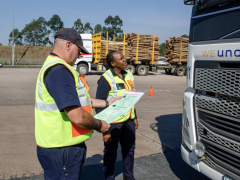
The scourge of truck hijacking – both within South Africa’s borders and overborder – is taking its toll on transport operators. And, according to Barney Curtis, executive officer of the Federation of East and Southern African Road Transport Associations (Fesarta), it’s a major worry for overborder truckers from all the sub-Saharan nations. So much so that Fesarta and its local associate body the Road Freight Association (RFA) have had meetings with the SA Police Service (SAPS) to try to find some answers. “The RFA is now continuing to pursue this matter,” Curtis told FTW. “So yes, it is a big problem, but it’s one that we’re dealing with.” From the insurers’ point of view, their claims records speak for themselves. Said Mike Brews, chief operating officer of SA’s major marine underwriters, Associated Marine: “Of all the transport companies on our books, and we insure a lot, 99% are covered for hijacking. It’s one of their biggest risks.” And a primary answer, he added, is that they must control that risk. According to Brews, that means that this risk control must include such good habits as trucks having two drivers, and only stopping (the highest point of risk) at approved, and well-managed, truck stops. “That, and armed guards for particularly high-value cargoes, seems to be working – and under this code of good practice we haven’t seen the hijacking trend increasing.” And where the trucks are travelling varies the risk level. Gauteng has been identified as the truck hijacking capital. Mpumalanga recorded the second highest number of hijackings, while KwaZulu-Natal ranks third. And Free State is not far behind. All the areas where the largest numbers of trucks operate in or through. The actual number of hijackings, at least within the borders of SA, seems to be decreasing – although some commentators have warned that this might just be a cyclical downswing. But it’s still not a return to a utopian state, with SA still having an abnormally high rate of truck hijacking compared to most other developing nations. And it’s frighteningly high when compared to the rates in developed nations. According to the latest figures available to FTW, a total of 8 565 truck hijackings in SA were reported to the police between 2004 and 2012. They continued on an upswing from 2004, until they peaked at 1 437 in the financial year of 2008/09 – with both years on either side of that date not far off that total. But, since 2009/10 the hijacking rate has continued to drop, until it reached 821 in 2011/12 – the lowest it has been since 2004/05. Carjacking, of course, records figures which are mind-blowingly higher. But there is a subtle difference in the intent of the two types of hijacking. In carjacking, the object is to steal the vehicle. The object of truck hijacking is generally to steal the load, which is easier to sell than the commercial vehicle itself. Truck hijackers are normally violent, professional thieves, who have planned the method of attack, the captivity of the driver, and a location where the trailer will be unloaded, and have the capacity to fence the load once they have it. Any load can be subject to hijack. It is not only vehicles that are pulling or carrying high-value loads. INSERT & CAPTION 99% of transport companies are covered for hijacking. – Mike BrewsBetween 2004 and 2012 a total of 8 565 truck hijackings were reported to the police
Moves afoot to address hijacking scourge
Comments | 0
© Now Media. This content is protected by copyright and may not be adapted or republished. If you would like to discuss cooperation opportunities, please contact: editor@freightnews.co.za.