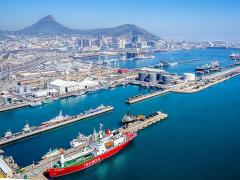
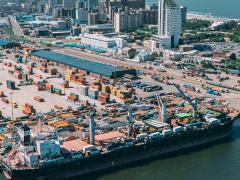
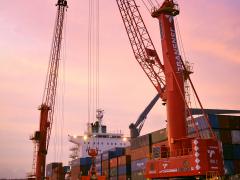
With two of South Africa’s original equipment manufacturers deciding to use Maputo as the preferred entry and exit point for both vehicles and components, the port is moving into the fast lane. One of the first major lines to use the port is Hoegh Autoliners. Maputo’s car terminal was built by Grindrod without a single signed order, according to Pieter Venter, general manager of the Grindrod Maputo Car Terminal. Research into the terminal started in 2001 “on the insistence of the original equipment manufacturers (OEMs),” he says. The terminal accepted its first vehicles in November 2007, setting the wheels in motion for major traffic. Obstacles in the way included road-side logistics, convincing the shipping lines to use Maputo and the usual resistance to change. Venter believes that all the components are now in place for the terminal to start speeding up. What is attracting the OEMs is the short distance between Maputo and Gauteng, the lack of congestion in the port, a clean environment, lower tariffs than Durban, and the systems in the vehicle terminal itself. It has one of the most sophisticated management systems of all the vehicle terminals in Africa, in addition to equipment such as an inspection booth which provides “showroom quality” lighting day and night to detect the finest blemishes. “Every move is planned beforehand on a flow diagram that tracks the vehicle from the time we first touch it to when we hand it over. This information is available to the OEMs over the internet.” A repair facility is being established for one of the OEMs. Vehicles are driven less than 150 metres from the quayside to the security of the vehicle handling facility. It has its own rail head and truck loading facility for dispatching the vehicles. Attention to detail includes issuing special clothing to drivers, all of whom have undergone extensive training. “Everything is based on the specifications provided by the OEMs and shipping lines,” he says. The terminal is geared to handle everything from motorcycles through trailers to high and heavy loads. It is also planned for expansion, with just the first phase being completed. Phase two has already been planned, with the electronic and fibre infrastructure already in place ready for the parking area to be paved. This will add 3 500 slots to the present 1 455 slots in phase 1, with phase 3 bringing the total to 7 500 slots. An additional two berths will be opened up to handle the additional shipping. In addition to serving the Mozambican, South African and other southern African markets, the terminal is attracting interest from shipping companies as a transit hub, according to Venter.
Maputo gears up for auto industry
Comments | 0
© Now Media. This content is protected by copyright and may not be adapted or republished. If you would like to discuss cooperation opportunities, please contact: editor@freightnews.co.za.