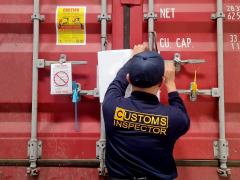
Importers who find their
goods stopped or detained,
especially in a case where
they need their goods
urgently, should take
proactive steps to get their
goods released. This often
means seeking legal advice
or going to court.
This was the general
consensus of several legal
advisers interviewed
by FTW on the issue of
customs stops, particularly
those involving groupage
shipments where one
consignee’s goods are under
suspicion but the entire
container – containing
multiple consignees’ goods –
is seized.
Berning Robertson,
senior associate in the
shipping and logistics
practice at Bowmans, and
Quintus van der Merwe,
partner in Shepstone
& Wylie’s international
transport, trade and energy
department, agreed that
customs had broad powers
to stop, detain and examine
goods. And they are not
required to provide an
explanation.
Van der Merwe added
that there were particular
laws governing counterfeit
goods – under the
Counterfeit Goods Act –
and that ideally, should one
consignment out of many
be suspected of containing
counterfeit goods, that
consignment should be sent
to a designated counterfeit
goods depot to be unpacked
and examined. “The rest of
the goods in the container
can therefore be released,”
he said.
But, it’s not as simple
as that. According to
Robertson it would not be
“unreasonable” for customs
officials to regard the whole
container as “suspect” and
detain all the
goods.
“There
are of
course strict
timelines
around this,”
added Van
der Merwe,
pointing
out that
those time
periods were
sometimes
overlooked.
“Over 90% of
the officials
involved
are doing
their job well and within
the regulation constraints,
but you do unfortunately
get the cowboys who f lout
the laws to the detriment
of the industry as a whole,”
he said.
Robertson told FTW
that the owner/importer of
the goods was entitled to
approach the courts for the
immediate release of the
goods on an urgent basis.
“It is doubtful whether
customs will attempt to
request more time for
further examination when
on the papers there is clear
evidence that the importer’s
goods are not counterfeit,”
he said, pointing out that
the court might award costs
to the owner/importer for
such an application.
He further pointed out
that in a situation where
the loss had already been
incurred – where a cargo
owner has lost business
due to his/her goods being
detained – the importer
might have
a legitimate
claim for
damage/
loss against
the South
African
Revenue
Service
(Sars).
“This will
however
depend on
whether
Sars acted
contrary to
the Customs
Act and
this action
resulted in the loss/
damage for the importer.
Furthermore, the importer
must be able prove his
losses/damages. Where the
loss/damage is an estimate,
proving such a loss is
always difficult,” explained
Roberston.
Tinus Barnard, director
of Customs and Legal at
dispute resolution firm,
Custex Consulting, agreed
that going to court was
sometimes the only option
available. “Getting an
answer from the customs
and border police officials
is impossible. But of course,
taking the legal route can
also be time-consuming and
expensive,” he added.
INSERT AND CAPTION
The owner/importer
of the goods is
entitled to approach
the courts for the
immediate release
of the goods on an
urgent basis.
– Berning Robertson
Importers must act with urgency
Comments | 0
© Now Media. This content is protected by copyright and may not be adapted or republished. If you would like to discuss cooperation opportunities, please contact: editor@freightnews.co.za.