With volumes of
commodities
and containers
on the Maputo
Corridor set for sustained
growth there is renewed
attention on ensuring that there
are no bottlenecks and delays,
says Barbara Mommen, chief
executive officer of the Maputo
Corridor Logistics
Initiative (MCLI).
“Over the years
there has been
a dramatic
increase of
interlink
vehicles, with
between 800
and 1 000 trucks
per day clearing
through our border
post port bound.
“It appears that this situation
will not change
any time soon, and will in fact
increase. Information we have
is that the very favourable
conditions for chrome are set to
continue for the next while, and
plans are also afoot to increase
container traffic by road in the
next 18 to 24 months.
“We must have a plan to deal
with the added volumes through
our border, on our roads, and
in our port. And by ‘we’, I mean
all stakeholders – public and
private,” she says.
Delays in August
once again
highlighted the
knock-on effects
of border delays,
which are most
often caused by
a single factor
alone.
“The ripple effect
of these delays is
significant. Congestion
affects every point on the
corridor.”
Mines struggle to meet
delivery targets and contractual
obligations when trucks are
delayed at any point on the
corridor.
Delays also raise the cost of
logistics.
“Transport operators lose
revenue. Vessels are either left
waiting in port (at a whopping
$65 000 to $140
000 dollars per
day), or they
depart with short
shipments.
“This in turn
increases the
cost to the cargo
owner, and affects
overall confidence
in the corridor,”
she says.
Such delays
should be a thing of the past as
the infrastructure and systems
are in place to ensure there is
a smooth f low of imports and
exports along the corridor.
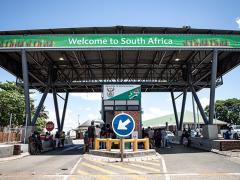
“When things work well, the
best case scenario is trucks
clearing the border post in
28-40 minutes, which is
excellent by African corridor
standards.
“While this is no small
achievement, I know that this
is way below what the Maputo
Corridor is capable of.
“Our vision is
for compliant
operators to
be able to
drive directly
through a one
stop border post
without spending
more than 10
to 15 minutes
on processing
documents.
“The three
things which corridor must have
in order to be viable for trade
are predictability, reliability and
efficiency.
“We need to work towards a
point where these fundamentals
define everything we do on the
Maputo Corridor,” she says.
INSERT & CAPTION
When things work
well, trucks clear the
border post in 28-40
minutes.
– Barbara Mommen