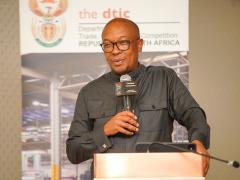
Government is working on a plan that will help prevent redistributed land being used as collateral, Land Reform Minister Gugile Nkwinti said on Thursday. "We know that when people are in trouble, they go to the bank and use it [their land] as collateral, and the land is taken away," he said at a televised The New Age breakfast briefing. "We don't want them to lose their land for a second time." Nkwinti was referring to the Khoi-San people and their descendants who were dispossessed of their land after the 1913 Natives Land Act, and who are now benefiting from land restitution and financial compensation. He noted that the Khoi-San people had lost land even before 1913. Wednesday marked 100 years since the passing of the act. Nkwinti said land redistribution was not only about owning land, but also about production and sustaining it. Government wanted every household to be treated like a basic production unit, he said. It wanted to introduce a new system where banks could not use redistributed land as collateral. The briefing heard that most of the claims lodged were for financial compensation. Nkwinti said out of 76 000 claims, about 71 000 claimants wanted financial compensation. He said R6 billion was used for this. Some 5856 people had wanted land. "It's a challenge we must engage on... we encourage them to go for land. "KwaZulu-Natal and Mpumalanga go for land; the others go for money," Nkwinti said. Deputy Land Reform Minister Lechesa Tsenoli said the land reform programme had helped improve the quality of life of the Khoi-San people and their descendants. "Compensation is a legitimate claim, like for example old people..." Elderly people and others used the money to better their lives. "[Elderly] People, they improved the quality of their lives, they contributed to the education of their children... and it has helped deal with hunger problems," he said. Government was trying to create quality conditions to undo what was done by the 1913 act. "Part of our work is to rehabilitate soil... environmental protection..." he said. Former land affairs department director general Gilingwe Mayende said cash payouts were a substantial proportion of the settlement. The more equitable approach was land benefits. "It is a worrying phenomenon... but people have a choice. They must decide whether they want the land or the cash." Mayende said in rural areas more people opted for land. But in urban areas, more people opted for cash to improve their living conditions. But land reform was on a positive trajectory despite problems. "As we speak, something around eight million hectares [of land] has been redistributed in the space of about 18 years." One problem was that the programme was expensive. "It's close to R30bn... that has been spent on [land] redistribution..." Earlier in June, Nkwinti reportedly said R16bn had been spent in settling 77 148 claims since the beginning of the land restitution programme. He told the National Council of Provinces that R10bn had been spent on land acquisition and R6bn on financial compensation claims that would have required 1.9 million hectares to be bought by government. Nkwinti said then the objective of land reform was to rekindle the class of commercial farmers which was destroyed by the 1913 act.
Government speaks out on land redistribution
Comments | 0
© Now Media. This content is protected by copyright and may not be adapted or republished. If you would like to discuss cooperation opportunities, please contact: editor@freightnews.co.za.