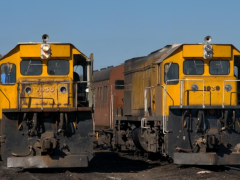
Fuel costs and rising salaries have pushed up logistics costs in South Africa and the industry will need to think out of the box to come up with solutions to an issue that is compromising economic growth. That’s a key finding of the tenth State of Logistics Survey released last week and published by the Council for Scientific and Industrial Research (CSIR) in collaboration with Imperial Logistics and Stellenbosch University. It looks back over a decade of measuring logistics costs while for the first time providing a forecast of the current calendar year’s costs. It points out that a disproportionate growth in cost drivers rather than a deterioration in efficiency is the main reason for South Africa’s rising logistics costs. In 2012 the absolute cost of logistics was R393 billion. The estimate for 2013 is R423 billion while the expected figure for 2014 is between R456 billion and R470 billion, depending on fuel inflation. Fuel is clearly the key cost driver, according to Professor Jan Havenga, director at the Centre for Supply Chain Management at Stellenbosch University. “A few years ago fuel contributed 30-35% to transport costs but it’s now approaching the 40% mark.” This year, however, drivers’ wages have emerged as a growing concern. “It’s always been important in terms of transport costs,” says Nadia Viljoen, scientific editor of the survey. “But now with recent events we are becoming aware of the state of wages and how important your people are,” she said. In Viljoen’s view South Africa’s logistics is highly efficient. “But improving it is not just about doing what we have been doing better. We can’t merely carry on as we are, saving fuel as we go and keeping stock down. It’s about changing the way we transport in our country as a whole – about addressing infrastructure and about changing the way the private sector does supply chain.” Hans Ittman of HWI Consulting believes that as a logistician, you can make your trucks more efficient, you can improve the load capacity of your trucks – you can do a lot of things – but eventually the big difference comes with the use of different modes. “The biggest shift needs to be to get stuff back on rail. But Transnet can’t do it on their own.” Facilitating the road to rail shift is top of the agenda for TFR, but executive manager Sandra Gertenbach says rebuilding industry confidence is one of the biggest challenges they face. “We come from a legacy of declining market share and services and have to turn that around. A big part of it is improving efficiency and we are already starting to see a turnaround." TFR welcomes private sector participation, she said, and has entered into deals with Imperial Logistics and Barloworld Logistics. Fanie Pretorius of the SA Shippers’ Council believes an important element of rail’s regeneration is its interaction with the port. We need to see reliability and predictability. “But what needs to be looked at is not only rail but the port interaction,” he said. Ultimately it’s all about greater supply chain integration. “Industry is very good at optimising what it does function by function, “ says Viljoen. “What we need to see is integration across all functions in the supply chain so that there is visibility and everyone is working together to achieve the same goals.” And it’s not only about transport and logistics. Cobus Rossouw, chief integration officer at Imperial Logistics, says that the industry must link macro economics with business and micro economics. “We’ve started looking at the economic structure of the country, how it influences logistics and how logistics influences that,” he said. “There’s a drive towards more local beneficiation and that may change the way freight flows in our country – which may influence the logistics sector. The question is whether there is anything the logistics sector should do to make local trade flourish. If the economy does well the logistics sector does well so it’s in the interests of the logistics sector to do things that will make the economy grow.” INSERT & CAPTION 1 It’s about changing the way we transport in our country as a whole _ about addressing infrastructure and about changing the way the private sector does supply chain. – Nadia Viljoen INSERT & CAPTION 2 If the economy does well the logistics sector does well so it’s in the interests of the logistics sector to do things that will make the economy grow. – Cobus Rossouw
Fuel and salaries push up logistics costs
Comments | 0
© Now Media. This content is protected by copyright and may not be adapted or republished. If you would like to discuss cooperation opportunities, please contact: editor@freightnews.co.za.