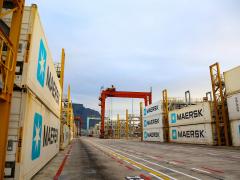
Durban truckers have confronted Transnet Port Terminals (TPT) on two fronts – one being months of growing congestion at the Durban container terminal (DCT) and the second being the truck booking system, the supposed answer to the delays. FTW was told that the Durban Harbour Carriers’ Association (DHCA) – part of the SA Association of Freight Forwarders (Saaff) in Durban – had been inundated with requests to investigate the long delays at DCT. This problem was reflected in the figures in TPT’s own daily reports for June 5 and June 6. On June 5, the truck moves were 2 196 and waterside moves 1 985. “Neither of these figures were great shakes,” said the DHCA report. Looking at productivity, DHCA chairman Kevin Martin told FTW that the first shift took an average of 37 minutes for each move; the second 201 mins (3 hours 21 mins); and the third shift 317 mins (5 hrs 17 mins) per move. The overall average to make the total of 2 196 moves was 161 mins (2 hrs 41 mins). It has to be noted, said Martin, that the second and third shifts started late due to a planned road show to staff – which the transport industry had been told about the previous week. On June 6, the average for the total of 2 432 moves was 186 mins (3 hrs 6 mins) per move. Again it should be noted that the first shift started late due to the planned road show. “However,” said Martin, “the waterside was wind-bound for nearly eight hours (14:00 to 22:00 hours) – first only at certain berths, then all berths after two to three hours. This should have released extra equipment to the land side to assist in clearing the backlog, but that didn’t happen. “As we told TPT at a meeting on the Monday before these dates, the above figures are averages over the whole terminal – not each tower – so some trucks are waiting six to eight plus hours for service.” But the answer, according to TPT, will be contained in the new truck booking system that it intends to introduce soon. According to DCT terminal executive, Hector Danisa, TPT kicked off the pilot phase of its new truck appointment system at DCT: Pier 2 on Monday, June 4 – with three transport companies involved in the process. “The new system aims to improve the scheduling of road transport companies using the terminal,” he told FTW. “DCT: Pier 2 will roll it out to other companies on a phased approach each month, but only once the system works seamlessly with the existing companies.” The terminal had scheduled feedback sessions with these companies for June 8 to discuss the system’s performance in its first week of introduction. To date transporters have been served at DCT: Pier 2 on a first-come, first-served basis. But, as was recorded in the DHCA’s latest complaint, the terminal has sometimes come under fire from truckers for long waiting times outside DCT during busy periods. Said Danisa: “Under the new system, transport companies would schedule their container collections or drop-offs via the web-based Navis Sparcs N4 terminal operating system, which has been in use at DCT since last year. The system would allocate them a time slot of about one and a half hours within which their drivers may arrive at the terminal.” Danisa had great hope for this new system – despite the fact that the multi-purpose terminal (MPT) has just moved from an unworkable booking system to firstcome, first-served, with TPT showing a 45% improvement in equipment utilisation. But the truck booking system won’t work, and never has in the past, according to the DHCA. A memo to members pointed out that when DCT was a regulated “closed shop” – ie, only Portnet road transport was allowed into the terminal (or only one transporter servicing them), they tried to implement a booking system. Ronnie Holtshausen – a very senior manager and a highly competent man – tried for over a year to implement a booking system – and failed. The reason, said DHCA, was that there were just too many problems outside of the terminal – in the general market place – to make it work. “Given that it couldn’t work with just one transporter and much lower volumes, isn’t it rather like wishful thinking to expect that it will work now? We think not,” said Martin. The MPT example was raised again by Carl Webb – Saaff and DHCA representative for MPT – who, early this year, convinced them to go for an open daily booking, on a first-come, firstserved basis. “Lo and behold,” he said, “the MPT now found, by their own records, that – on an open first-come, first served basis – a 45% better equipment utilisation was achieved. “The smoke and mirrors of the truck booking system and the proposed miracles it will bring are just that – smoke and mirrors,” said Martin. “I am not anti the system – just the proposed thinking behind its present implementation."
Durban’s lengthy delays under fire again
Comments | 0
© Now Media. This content is protected by copyright and may not be adapted or republished. If you would like to discuss cooperation opportunities, please contact: editor@freightnews.co.za.