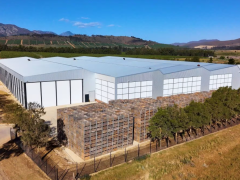
As businesses remain under pressure to reduce costs in a difficult economic environment, cold chain efficiency has become far more critical. According to Dr Johan Ferreira of Cafeine Retail, a niche Cape-Town based consultancy focused on the integrated retail value chain, an efficient cold chain has massive value in terms of cost and energy savings. “We often find that companies believe their cold chain is very efficient when the exact opposite is true. Different products have different temperature requirements and it can be challenging to ensure these are met at all times in the cold chain,” he told FTW. In a recent study of a major retailer’s premises Ferreira and his team found that when different temperature measurements were taken over a period of time in the distribution centre alone the variations in temperature were so vast that the products on average were not being kept at the optimum temperatures. “The impact of this is that food safety and quality is compromised, but the knockon effect is far greater as sales will ultimately be affected. Not only does it mean a shorter shelf life for some products, but often there is much more wastage as products have to be discarded as they have not maintained quality through the chain.” According to Professor Malcolm Dodd, who works alongside Ferreira, the first step to efficiency is understanding one’s cold chain and its requirements. “At the same time it is about thinking of the whole space you are chilling as a differential of different temperatures. If you don’t approach it differently you will definitely see shorter shelf life of products and fewer sales. It has a major domino effect.” Both Ferreira and Dodd advocate that businesses across the supply chain take the time to make sure they have an efficient cold chain. “Managing a cold chain is not as simple as just having a minimum temperature cold chain facility. Temperatures need to be measured in a threedimensional grid to establish a thermal map of the reality of the situation. This map can then be used to reconfigure the refrigeration equipment for optimum efficacy. “It requires time and effort to get a clear understanding of the various requirements of the operation and then the application of the correct methodologies to ultimately bring about the reduction in operating costs and increased product sales,” said Ferreira. INSERT & CAPTION 1 Temperatures need to be measured in a three-dimensional grid to establish a thermal map of the reality of the situation. – Malcolm Dodd INSERT & CAPTION 2 Companies often believe their cold chain is very efficient when the exact opposite is true. – Dr Johan Ferreira CAPTION Managing a cold chain is not as simple as just having a minimum temperature cold chain facility.
Cold chain efficiency
Comments | 0
© Now Media. This content is protected by copyright and may not be adapted or republished. If you would like to discuss cooperation opportunities, please contact: editor@freightnews.co.za.