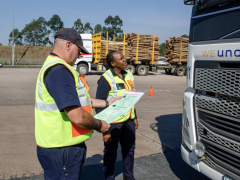
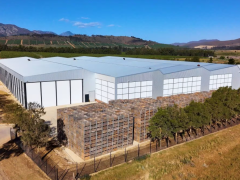
Traditional in-house information technology (IT) infrastructure has become a hindrance to warehouse operations, according to Jacques Whittle, managing director of the Corporate Renaissance Group (CRG). Based in Port Elizabeth, CRG has offices in Canada, India, and the United States, and it has implemented some of the biggest and most complex warehouse systems in South Africa. Whittle, who has just returned from the National Retail Foundation (NRF) show in New York, believes that the future of warehouse management lies in having management systems in the cloud rather than in-house servers – particularly as companies expand into the rest of Africa. Proven and flexible cloud-based systems can be implemented for “half the cost” of in-house servers, and without the expense of ongoing maintenance and technical support. More importantly, he believes, cloud-based systems provide more flexibility. They are used to integrate warehouse and transport operations across any distance. This means that managers can operate warehouses in Johannesburg, Lusaka and Lubumbashi as a single operation “from anywhere in the world”, for example. The same system can manage smaller distribution warehouses – or areas within third party warehouses – across a metropolitan area like Gauteng in order to provide optimal routing. Modern systems have the intelligence to identify buying trends, which enables companies like online retailers to ensure that products are made available as close as possible to the customers by anticipating demand. A warehouse system installed by CRG in Gauteng and Cape Town delivers goods to the door of buyers within a 60 km radius in “three hours from the click of the mouse to buy the product,” he says. This is possible because cloud-based warehouse systems can also manage the rest of the transport and logistics chain. Owner-drivers of anything from a scooter to a superlink can be integrated into the distribution system through an app. The app tracks the driver and vehicle and can either send them a routing instruction or request a quote for the load. “In this way the warehouse operator can ensure that they control costs and that there is optimal routing of the vehicles carrying the goods,” he says. Once the driver has accepted the load instruction, the app takes him to the pick-up point and then to the destination – using the least cost route. It tracks the load and driver, who can take a photograph of the load when it is accepted and again when it is delivered. The consignee signs for the goods on the smartphone and all the information, including photographs, is automatically captured by the system. “The driver is then ready for the next load,” says Whittle. Again, the control room and driver can be on opposite sides of the world. Cloud-based systems are also ideal for value-added logistics operations such as assembly, he adds. Whittle believes that South African warehouse operators are in danger of losing out on opportunities because of being “stuck in the old paradigm of control. They believe that having a costly server on site gives them control”. Much of the resistance comes from the finance and accounting departments. “We tell them that they can keep their mainframes and systems. The warehouse management system is a stand-alone which can be fully integrated into the accounting back end,” he says. INSERT Managers can operate warehouses in Johannesburg, Lusaka and Lubumbashi as a single operation “from anywhere in the world”.
Cloud-based solutions can halve costs
Comments | 0
© Now Media. This content is protected by copyright and may not be adapted or republished. If you would like to discuss cooperation opportunities, please contact: editor@freightnews.co.za.