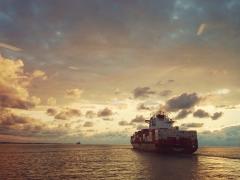
As the global container fleet size revolution continues – along with mergers and alliances – a UK shipping consultant has labelled the industry as “close to a monopoly situation”. Speaking at the 12th Intermodal Africa conference in Durban last week, Steven Wray, principal consultant at UK-based Ocean Shipping Consultants, said that 21 shipping lines controlled 86% of total capacity. “There have already been a number of mergers and acquisitions and there are still a few to come,” he said. Vessels larger than 10 000 TEUs represented 4% of the global f leet in 2006, Wray said, but this would rise to 20.5% in future. “Shipping lines are ordering bigger and bigger ships, despite the fact that they don’t have the demand to fill them. That in turn is driving the need for alliances and consolidation, purely so shipping lines can get together and fill these large ships and take advantage of economies of scale,” he said. But for an industry where profits are at an all-time low – with annual results telling the woeful tale – it’s about survival. On most major routes freight rates are regarded by lines as unsustainable, which is why economies of scale coupled with alliances and mergers are seen as possibly the only solution. “The focus is now on vessels of more than 8000 or 10 000 TEUs. All of the top 20 shipping lines have committed to ordering these vessels,” Wray said. There were 229 vessels with greater than 10 000- TEU capacity in June 2014 and 134 vessels were expected to come into operation by the end of 2016, he added. The Europe/SA has already seen a rise from 4425 TEUs to 6050 TEUS on average in 2014. “The role of 10 000- TEU plus vessels is on the increase. The main arterial trades aren’t able to absorb all of the new tonnage so we have the cascade of some vessels onto secondary services,” he said. Wray said the size of vessels deployed on the Asia/UK/Europe trade was expected to increase to an average of 20 000 TEUs by 2030. “There are already designs in the pipeline for vessels greater than 20 000 TEUs. There are designs for 22 000- and 24 000-TEU vessels, which some shipping lines have already declared a significant interest in,” Wray said. Asked to comment on the allegation that shipping lines were running “close to a monopoly”, SA Shippers' Council CEO Brenda Horne Ferreira said: “I don’t want to respond at the moment because there is a current case pending at the Competition Commission and I must first ask the council to look in an informed manner at the entire thing,” she said. The Competition Commission had not responded to questions at the time of going to print. CAPTION The 18 270-TEU Mærsk Mc-Kinney Møller, the lead ship of Maersk’s Triple- E container vessels, has the largest cargo capacity in TEU of any ship yet constructed, and is the longest ship in service worldwide as of 2014. Photo: Maersk Line
Big ship revolution forces alliances and mergers
Comments | 0
© Now Media. This content is protected by copyright and may not be adapted or republished. If you would like to discuss cooperation opportunities, please contact: editor@freightnews.co.za.