MBABANE – Swaziland Railway
is eager to boost freight
volumes to realise the line’s objective
to transport 12 million tonnes
of cargo per annum, Stephenson
Ngubane, CEO of Swaziland
Railway, recently told FTW. Linking
the country’s sugar belt by rail is one
contemplated means to increase
haulage, while the provision of a one–
stop service, initiated as far back as
1993 at the inception of the dry port
(Inland Clearance Depot), is being
extended through the placement of
customs officials from the Swaziland
Revenue Authority (SRA) at the dry
port.
“The latest innovation, part of our
continuous improvement of services,
reduces document processing time
by having clearing agents on hand
to aid exporters with their clearance
certificates. This makes it easy for
shippers to get their products out of
the country. The SRA has introduced
automated pre-clearing of cargo
to increase the speed of clearance
at this facility, which has become
the number two port of entry in
Swaziland in terms of value of goods
and collection of revenue,” Ngubane
said.
"The European Union mission to
Swaziland believes more utilisation
of the nation’s rail system will assist
economic growth and poverty
reduction, and co-sponsored a
recent business conference to allow
Swaziland
Railway to
showcase the
rail transport
option,” he
said.
“Given the
linkages that
exist in the
rail industry
of the region,
we can take
goods as far as Zambia and even
the Democratic Republic of Congo
in a short space of time. SR has the
narrow gauge track like all the
railways in SADC – 12 railway
operators,” Ngubane said.
The most expedient means of
upping rail use is to move sugar,
Swaziland’s main agricultural
export, which as a bulk product lends
itself to cheaper haulage via rail.
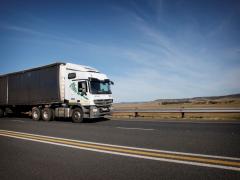
“Most of the sugar that is exported
out of the country is transported by
rail. However, there is no rail track
that exists at the points where the
sugar is processed.
Thus the sugar
companies first
have to load the sugar onto trucks
and transport them to the dry port
where bagged sugar can be loaded
into containers to overseas and
continental markets. This is at great
cost to the sugar companies. An
investment in a rail line that would
be closer to their processing plants
would reduce their shipping costs
and increase their efficiency,” he said
In terms of improving technology,
Ngubane said, “Swaziland
Railway uses a radio-based train
communication system for train
movement authorisation which is
supported by a computer system
sequencing and controlling the
issuing of tokens. The driver requests
the TCO for authority, and the two
exchange information which
they record manually, but
also through a voice logger
for future reference
to assist in tracing
conversations between
drivers and the TCO.”
INSERT & CAPTION
We can take goods as far
as Zambia and even the
Democratic Republic of Congo
in a short space of time.
– Stephenson Ngubane
Automated clearance adds value for Swazi Rail customers
Comments | 0
© Now Media. This content is protected by copyright and may not be adapted or republished. If you would like to discuss cooperation opportunities, please contact: editor@freightnews.co.za.