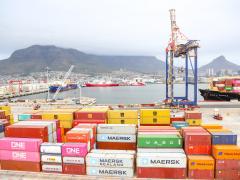
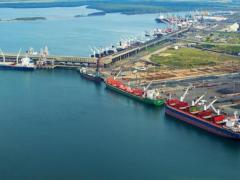
Delay of 80 hours as 3 580 boxes are loaded and discharged RAY SMUTS A HUGE delay of more than 80 hours notwithstanding, Safmarine’s second new ‘Big White’ on her maiden voyage to South Africa recently, the 3 700TEU Safmarine Nokwanda, set an all-time record for the Cape Town container terminal by loading and discharging a total of 3 580 boxes. “Yes, it was the highest call size we have ever had here,” said Sapo planning manager Derek Goetze, estimating that the previous two newbuild containerships, Lars Maersk and Nokwanda’s sistership Safmarine Nomazwe (all deployed on the new-look SAECS service), probably loaded and discharged 50% fewer boxes. Goetze, describing the mammoth task which took all of six days to complete, paid tribute to Sapo’s operational staff for sticking to the mandate of maintaining fluidity throughout what must have been a tricky exercise. “The average call size per vessel in Cape Town is 535 containers, so in addition to having to handle a seven-fold greater cargo on Safmarine Nokwanda, Sapo personnel also had to deal at the same time with 1 000 empties coming off SA Sederberg (now deployed on the SAFARI service between Asia and South Africa). Says Goetze: “We told the Safmarine people we could not accommodate 2 700 containers between the two ships at the same time. Our terminal is simply not big enough for that, resulting in the Sederberg being handled first.” Safmarine Nokwanda dropped anchor off Sea Point early on Saturday, February 12, where she lay for 55 hours - due in part to having to wait for cargo from SA Sederberg - before berthing the following Monday mid-morning. One can only wonder at the scenario when P&O Nedlloyd’s new additions join the SAECS fleet. P&O Nedlloyd Heemskerck and P&O Nedlloyd Livingstone (due at the Cape Town container terminal in March and April) are able to carry at least 1 000 more containers than the two new Safmarine vessels. What seems certain is that vessels with such large call sizes are bound to impact on schedules of other vessels in the terminal.
Nokwanda pushes port resources to the limit
Comments | 0
© Now Media. This content is protected by copyright and may not be adapted or republished. If you would like to discuss cooperation opportunities, please contact: editor@freightnews.co.za.